On Heddesheimer’s ‘First Holocaust’

This week, I’m republishing another piece I wrote last year for Holocaust Controversies blog.

If one thing becomes abundantly clear when one looks at the list of Holocaust Handbooks published by Castle Hill and CODOH, it is that they are overwhelmingly concerned with the Holocaust itself and, within that topic, the part of the Holocaust occurring within the concentration camp system. Where the handbooks are comparatively lighter is in any sense of the history of the Third Reich or of Jews – to say nothing of the intersection of the two in terms of Nazi Jewish policy – before the invasion of the Soviet Union in June 1941. If Hilberg dedicated the first sixth of Destruction of the European Jews to the events leading up to Barbarossa, we might perhaps expect that seven of the 42 HH books similarly address topics from medieval and early modern European antisemitism through the invasion and occupation of Poland by Nazi Germany; instead, we have essentially two — The First Holocaust by Don Heddesheimer and Jewish Emigration from the Third Reich by Ingrid Weckert — or 4.8%.[1]

Regarding Heddesheimer himself, little is known. No publications other than The First Holocaust appear in Worldcat under his name. Before the release of the book’s first edition in 2003, a single article by Heddesheimer appeared in the January-February 2002 issue of the Journal of Historical Review[2]; he also apparently authored a letter published in The Barnes Review in 1999. He has evidently been on the “revisionist” scene for some time as a subscriber to Willis Carto’s far-right “journal” and a contributor to Holocaust denial publications.

Both the first and second editions of The First Holocaust feature a preface by Germar Rudolf. The main thing to point out about this preface is that, like most of his writing, it is either profoundly dishonest or immensely ignorant of history. An illustrative example emerges if we compare the prefaces between editions. In the initial preface, musing on rumors of violence committed against Jews in Eastern Europe in the early 1920s, Rudolf writes that the New York Times “reported that there were some hostilities toward Jews in the Ukraine, but that this was stamped out violently with the help of a Jewish army of allegedly 500,000 soldiers — an army that could have been formed and operated only with the consent of the new Soviet authorities.”[3] He goes on to characterize the Red Terror perpetrated by this “Jewish Volunteer Army” and to note the sympathies of Zionist Jews with the USSR as a “Jewish dominated and controlled experiment of a Jewish led country free of anti-Judaism.”[4]

Totally missing from Rudolf’s commentary is that Russia was engaged in a brutal civil war, and while terror was used by both sides, the Jews in the traditional Pale of Settlement were subjected to some of the most horrendous incidents of mass violence, which dwarfed the earlier periods of pogroms in 1881-82 and 1904-06. Historians of the period estimate that 50,000 Jews were murdered in Ukraine alone, overwhelmingly by anti-Bolshevik forces (a small percentage were also committed by the Red Army). And while it is true that this anti-Jewish violence drove many Jews into the arms of the Red Army, the Zionists were not among them. With the exception of the left wing of the Zionist Workers Party Poalei Tsion, which fused with the Bolsheviks, all of the Zionist parties opposed the Bolshevik seizure of power.
In the most recent edition of the book, this material has been drastically revised. An entire page of new material has been inserted into the preface to now acknowledge that the civil war was going on but now also pointing a more direct finger at the “Jewish Volunteer Army,” before ending the section with precisely the same erroneous conclusion about Zionist support for the Soviet Union, still depicted as “a Jewish dominated and controlled experiment.”[5]

In addition, Rudolf sees fit in the preface to quote the Israeli daily newspaper Ha’aretz as “proudly proclaim[ing]: The war in Iraq was conceived by 25 neoconservative intellectuals, most of them Jewish, who are pushing President Bush to change the course of history.”[6] Calling up the actual article reveals that the text is a subheadline (called by journalists a “deck”), which itself is a paraphrase of something said by the subject of the interview in the article — New York Times journalist Thomas Friedman. Notably, the article subsequently states, “Still, it’s not all that simple, Friedman retracts. It’s not some fantasy the neoconservatives invented. It’s not that 25 people hijacked America. You don’t take such a great nation into such a great adventure with Bill Kristol and the Weekly Standard and another five or six influential columnists.”[7] Rudolf, of course, leaves all of that out.

To his credit, Heddesheimer is not nearly as sloppy or dishonest as his publisher, although he does provide some of antisemitism’s “greatest hits” in his book. For instance, in his discussion of mass repression in the Soviet Union during the reign of Stalin, he writes at length about L.M. Kaganovich, the long-time Soviet-Jewish apparatchik who served two terms as first secretary of the Bolsheviks in Ukraine and later as minister for transportation and deputy premier. Kaganovich, Heddesheimer writes, “was the Soviet official most responsible for the Ukrainian famine of 1932-1933. Some have even argued that Kaganovich was the real master at the Kremlin and Stalin a mere puppet.”[8] On this point, he cites Walter Laqueur’s Stalin: The Glasnost Revelations. The problem is that, in the page cited from Laqueur’s book, he is discussing the rhetoric used by the late Soviet era Russian far right; in fact, the exact point cited by Heddesheimer is one that Laqueur writes “first appeared in the Nazi literature fifty years before Kozhinov and his friends [figures on the contemporary Russian far right].”[9] Notably, on the very same page, Laqueur notes that, despite rumors to the contrary, Stalin did not have a Jewish wife, but Heddesheimer nevertheless repeats the baseless claim that, after Stalin’s second wife’s suicide, “Kaganovich introduced Stalin to his younger sister Rosa who was a medical doctor at a clinic in Moscow and within a year Rosa Kaganovich became Stalin’s third and last wife.”[10] Most laughably, Heddesheimer’s source for much of this material is Stuart Kahan’s long debunked Wolf of the Kremlin.[11]

Finally we come to Heddesheimer’s argument itself, which he builds bit by bit. It can be briefly summarized as follows. Heddesheimer argues that American Jews began organizing in support of Eastern European Jews in the 1880s, with the pace picking up during World War I and continuing into the interwar period. It was during these periods that use of the word “holocaust” began, along with the repeated evocation of the image of millions of Jews subjected to harm and suffering. Enormous sums of money were raised for Eastern European Jewry, but corruption consumed a fair amount. The money that was not siphoned off by corrupt people ended up assisting in the twin goals of funding communism and supporting Zionism.

If this material sounds fairly far afield from the well-trod Internet meme of “the Jews” having originated their six million hoax twenty (or fifty or even a hundred) years before the actual Holocaust, that’s because it is. In so far as the book addresses the point of six million Jews being a repeated trope or the term “Holocaust” having been used in the past, it is often either simply wrong – e.g., Heddesheimer’s assertion that the word “Holocaust” is a “World War One word,”[12] although it actually appears in Wycliffe’s Bible (the first to be published in England, 125 years before the Reformation) – or actually concessions that there were in all likelihood six million Jews living in Eastern Europe at the time the news reports that he cites were written.

If we accept the latter point regarding the actual size of Eastern Europe’s Jewish population between the world wars, then the argument is essentially over. If the trope of “six million Jews” is repeated in American mass media during the period, then it is thoroughly understandable that it would be. We should bear in mind that Russia had in fact conducted a rather thorough census of its empire in 1897, and while this census did not include “Jewish” as an ethnic group, it did include the enumeration of populations by religion and language spoken at home. With Judaism included in the former category and Yiddish in the latter, the number of Jews living in Russian Empire (which included most of what would become the Republic of Poland and the Baltic States following World War I) was approximated at five million.[13] Notably, this census was conducted after the mass migration of Russian Jews to North and South America, South Africa, Australia, and Palestine following the wave of pogroms in 1881-82. Moreover, since no small number of Russian Jews already no longer spoke Yiddish at home (Leon Trotsky’s family, for instance, spoke Russian at home), and many Jews had abandoned the Jewish faith, the census figure likely underestimated the number of Jews living in Russia.[14]

However, we should consider whether mentions of “six million Jews” in Eastern Europe actually appeared at a higher rate as claimed by Heddesheimer. It turns out that they did not. Searching the databases for the New York Times for the entire period from January 1, 1857, to August 31, 1939, returned the data shown in the table below.

MillionsEarlyPer YearLatePer Year
1350.53120.64
2380.58170.91
3350.53150.80
4310.4770.37
5110.17150.80
6200.30100.53
7150.2370.37
8140.2190.48
950.0830.16
10250.38160.85

In this table, “Early” refers to one database covering articles published between 1857 and 1922, and “Late” refers to a second database covering 1923 to August 31, 1939. The search was conducted such that both the numeral 6 and word “six” were investigated, as well as both “million” and “millions,” in keeping with usage over the past 175 years. The data clearly show that mention of six million Jews was generally less common than references to fewer Jews and generally more common than references to more Jews. The most commonly cited number of Jews in Eastern Europe was, in fact, two million.

In short, as noted by Andrew E. Mathis and Roberto Muehlenkamp in their debate with “Thomas Dalton” on Kevin Barrett’s “Truth Jihad” radio show in 2010, the whole trope of a “first Holocaust” amounts to an exercise in cherry picking. (Sergey Romanov has also responded to Heddesheimer’s claims as repeated as Internet meme, expanding his newspaper searches beyond the Times and investigating uses of the term “holocaust.”) Rather than a “dry run” for the later hoax perpetrated against the world by influential Jews to obtain funds for Jewish causes, the trope of six million Jews in newspaper reports before World War II was not even particularly common, especially given how often other figures were used. In the end, Heddesheimer’s book is less revelatory than it is warmed-over antisemitic conspiracy theories about Jewish media and monetary control.


[1] This consideration leaves aside the six “overview” volumes written and/or edited by “Dalton,” Kollerstrom, Butz, Graf, and Rudolf (2); removing these volumes from the total, we are left with 36 volumes, two of which treat topics before Barbarossa, for a slightly better proportion of 5.6%.

[2] Don Heddesheimer, “’Nothing Has Been Invented’: The War Journalism of Boris Polevoy,” Journal of Historical Review, 21, no. 1 (2002): 23-28.

[3] Germar Rudolf, “Preface,” The First Holocaust: Jewish Fund Raising Campaigns With Holocaust Claims During and After World War One, 1st ed. (Chicago: Theses & Dissertations Press, 2003), 13.

[4] Ibid.

[5] Rudolf, “Preface,” First Holocaust, 2nd ed., p. 26.

[6] Ibid, pp. 28-29.

[7] Quoted in Ari Shavit, “White Man’s Burden,” Ha’aretz, April 3, 2003, https://www.haaretz.com/1.4764706, accessed May 3, 2020.

[8] Heddesheimer, First Holocaust, 2nd ed., 96.

[9] Walter Laqueur, Stalin: The Glasnost Revelations (New York: Scribner, 1990), 251.

[10] Heddesheimer, First Holocaust, 2nd ed., 97.

[11] Paul Heineman’s review of the book Wolf of the Kremlin  in Slavic Review (vol. 48, no. 1, 1989) is particularly pointed, noting that “The errors, combined with the total absence of reference to prevailing western interpretations of major events, cause the reader to treat with great circumspection the ‘new’ information promised by the book’s cover” (p. 113). At the time of its publication, the Kaganovich family itself responded with a firm denunciation and denial that Kahan was, as he claimed, a family member. Kaganovich had denounced  Kahan as an impostor years before the book came out; see his May 31, 1982, letter to Gromyko in L. Kaganovich, Pamyatnyye zapiski (Moscow: Vagrius, 2003), 644-645. As can be seen from his memoirs (op. cit.) and talks with Feliks Chuyev in Tak govoril Kaganovich: Ispoved’ stalinskogo apostola (Moscow: Otechevstvo, 1992), he remained a fanatical Stalinist until his death in 1991, which is hardly compatible with an accusation that he murdered Stalin. For the true details of Stalin’s family life, interested readers are encouraged to consult Oleg Khlevniuk’s 2017 book Stalin: New Biography of a Dictator. A senior research fellow at GARF, Khlevniuk is among the most prominent contemporary Russian historians of the Stalin era.

[12] Heddesheimer, First Holocaust, 2nd ed., 51.

[13] Richard H. Rowland, “Geographical Patterns of the Jewish Population in the Pale of Settlement of Late Nineteenth Century Russia,” Jewish Social Studies, 48, no. 3/4 (1986): 207.

[14] Gennady Estraikh, “On the Acculturation of Jews in Late Imperial Russia,” La Rassegna Mensile di Israel, 62, no. 1/2 (1996): 217.
On Weckert’s ‘Jewish Emigration from the Third Reich’

This week, I’m republishing another piece I wrote last year for Holocaust Controversies blog.

Unlike Heddesheimer, Ingrid Weckert is a known quantity. She has a long career on Germany’s far-right; of all the HH authors, she has the clearest connections with the neo-Nazi movement in Europe, with Jürgen Graf a close second. Now in her 90s, she has spent the last 40 years writing exculpations of Nazi figures (including Julius Streicher and Josef Goebbels) and crimes (most notably Kristallnacht). Beyond contributions to Holocaust denial, she was closely affiliated with the neo-Nazi leader Michael Kühnen in the 1980s and participated in attempts to form legitimate far-right political parties —  most recently, Kühnen’s Deutsch Alternative, which was banned in 1992. Trained as a librarian, she also studied theology and history, including allegedly studying Jewish history in Israel.


Weckert’s contribution to the HH collection, Jewish Emigration from the Third Reich, is a translation of her Auswanderung der Juden aus dem Dritten Reich, which Castle Hill published in 2004. A slim volume numbering only 70 pages not including frontmatter, backmatter, and appendices, it attempts to strike a more seemingly conciliatory tone than much of Weckert’s previous work. Nevertheless, it repeats the grotesque errors of that work, with the typical lying by omission, whitewashing, and blame shifting found there. It is important to state at the outset that a thorough checking of Weckert’s use of source material is beyond the scope of this short review. That said, an earlier review by Andrew E. Mathis of Weckert’s article on Kristallnacht in the Journal of Historical Review (summer 1985 issue) found that she was a routine abuser and misrepresenter of her cited sources.[1]


After a short introduction in which she assures her reader that Jewish emigration from the Third Reich was an orderly affair undertaken with the utmost decorum by the Nazis, Weckert begins her examination of her topic with a short discussion of the famous “Jewish Declaration of War” against Germany on March 24, 1933. In making a notable concession many deniers do not – i.e., that “the Jews” had no state with which to war wage against Germany – she nevertheless engages in antisemitic stereotyping, writing, “As World Jewry did not have its own state, it used the power at its disposal, namely its influence on the world economy, to impose a world-wide boycott of Germany.”[2]


The “Jewish Declaration of War” is a stock in trade of denier rhetoric, so while it is really beyond the scope of Weckert’s book, it nevertheless requires some discussion. Like many of her colleagues, Weckert expresses outrage at the idea that Jews around the world might boycott Germany in 1933, given the poor economic situation there – apparently not considering the outrage that Jews worldwide might feel that one of the Europe’s great powers had seen fit to elevate to its leadership a rank antisemite and his political party. Nor do most deniers acknowledge what these Jewish communities knew, i.e., that the Nazi regime was already unleashing violence on the German Jewish community. 


The leadup to the March 5, 1933, election was particularly brutal, with the aftermath even worse. Thomas Childers describes it thus:
On March 9, SA squads moved into a Jewish neighborhood in Berlin, rounded up dozens of Eastern European Jews, and packed them off to a concentration camp; four days later Brown Shirts in Mannheim invaded Jewish businesses, roughed up their owners, and shut down the shops; later that same day in a small Hessian town, Storm Troopers, “in search of weapons,” forced their way into the homes of local Jews, ransacked the rooms, and brutalized the terrified inhabitants; in Breslau, SA men stormed brazenly into a courtroom, attacked Jewish lawyers and judges, and drove them out of the building.[3]

Notably, Childers concedes that this violence was not organized or authorized by the regime itself, but he also notes that it was the particularly violent aftermath of the March election that resulted in the call for a Jewish boycott of German goods.[4]


Weckert acknowledges none of these points. She also does not acknowledge the extent to which the idea of a boycott of German goods was controversial even among Jewish communities themselves. For one thing, German Jews themselves had pled with the U.S. Jewish community not to attack the new government. Notable voices of dissent against the boycott were the American Jewish Committee’s Cyrus Adler and the British Board of Deputies’ president Neville Laski. As David Cesarani writes, “close scrutiny of the Jewish response in February and March 1933 would have revealed only division and dissonance. There was no chorus of ‘international Jewry.’”[5]


Weckert’s second chapter describes the organizations representing Germany Jewry in the early years of the Nazi regime. Here, a clear distinction emerges between what we might call “national” Jews and Zionists. Whereas the latter were Jewish nationalists committed to creating a Jewish national home in Palestine, the former considered themselves German citizens of the Jewish faith and identified strongly as German nationalists. Weckert’s description of the Zionists is informative: “The National Socialist attitude corresponded in principle to the Zionist position. They wished to establish a nationalistic Judaism and thus opposed any inner Jewish attachment to anything German. But they approved of National Socialism because they shared its basic tenet: devotion to one’s own people and state.”[6] In short, the Zionists were the Jewish equivalent of the Nazis, so any cooperation or collaboration between the two groups should be considered natural.


In the next couple of chapters, Weckert details the different civil society organizations involved in the promotion of Jewish emigration and then discusses the Ha’avara, or Transfer, Agreement enacted between the Nazi government and the Zionist community in Germany and Palestine. Amusingly, in introducing the topic of Nazi-Jewish collaboration in emigration projects before the war, she admits that Ha’avara has become a standard feature of histories of the Holocaust, but she claims that the Rublee-Wohlthat Agreement “generally falls under the historical blackout.”[7] Similarly, about one source on Ha’avara on which she relies rather strongly – Werner Feilchenfeld, Dolf Michaelis, and Ludwig Pinner’s Haavara: Transfer nach Palästina und Einwanderung Deutscher Juden (1972) – she writes that it “has obviously not been read by most people who write about the Haavara.”[8] To put it plainly, this assertion is false. A Google Scholar search finds that the publication by Feilchenfeld et al is cited by 53 other publications, including ones by Francis Nicosia (cited by Weckert herself) and Avraham Barkai (ditto); the scholars discussing the Rublee-Wohlthat Agreement include Richard Breitman, Christian Gerlach, Hans Mommsen, and Kurt Schleunes – four of the most important historians in the field. For someone claiming to be in possession of secret knowledge, Weckert has sources that have been broadly cited.


In her chapter on Ha’avara, Weckert reiterates many of the errors she made in discussing the topic in her writings on Kristallnacht. For instance, she asserts that Jews emigrating to Palestine under the agreement were exempted from the Reichsfluchtsteuer (Reich flight tax – a tax assessed on all emigrants as a way of not draining too much currency from Germany’s already scarce reserves); they were not.[9] Moreover, in depicting the agreement as beneficial to the Jews who emigrated to Palestine, she omits several key negative aspects of the agreement. For instance, Germany tended to freeze the vast majority of the currency of the emigrant in German accounts; this money could only be ransomed by the emigrant agreeing to accept an unfavorable exchange rate. In his book on Ha’avara, Edwin Black notes that some emigrants found that, by the time their money was fully out of German hands, they had lost more than half due to this exchange rate and the Reichsfluchtsteuer.[10]


Further, Weckert’s understanding of the immigration process to the Yishuv in Palestine is deeply flawed. She writes, “The Haavara was beneficial to those Jews unable to raise the one thousand pounds required in order to go to Palestine.”[11] In fact, not every immigrant was charged a thousand pounds. Rather, Jews intending to immigrate as capitalists (rather than as farmers) were charged this fee by the Yishuv.[12] This fact underscores an important point about the emigration of German Jews to Palestine that Weckert does not address at all: German Jewry was overwhelmingly middle class, with its population largely employed in business and white collar professions.

The Yishuv – particularly the left-wing mainstream of the Zionist movement – didn’t want these Jews in Palestine. It wanted Jews who would be willing to work the land and build a Jewish state based in agriculture that would be self-sufficient. Whereas for the largely poor and working class Jews of Eastern Europe, this offer was potentially attractive, for German Jews, it was decidedly not – thus, the comparatively small number of Zionists in Germany compared to the countries to its east. The conclusion that Weckert avoids stating is that German Jews paying this thousand-pound fee were leaving for a country in which they actually had no real desire to settle and in which they knew they were largely unwanted. Although many German-Jewish Zionists would take advantage of the agreement, many other German Jews who did were not Zionists and were instead leaving because they knew the country of their birth was oppressing them.

Weckert’s fifth chapter, “Emigration and the SS,” details the work done by the SS to encourage Jewish emigration in the early years of Nazi rule. In a footnote to that chapter, she writes, “It is surely a paradox for those who have derived their historical knowledge from the media, wherein the SS is depicted as a murderous Third Reich gang, with chief responsibility for the Jewish ‘Holocaust.’”[13] This statement is either catastrophically ignorant or deeply dishonest. No credible historian claims that the extermination of the Jews was a project of the SS in the 1930s. Among Weckert’s more remarkable claims in this chapter is that, after Kristallnacht, “it was the SS that sent a team to clean up and to ensure that the office would be functioning again as soon as possible.”[14] She cites a book by Francis Nicosia on this point, but the single reference to the destruction of the Palästinaamt (Palestine Office) on Kristallnacht that Nicosia offers (on a different page than that cited by Weckert) states only that, at Adolf Eichmann’s trial in Jerusalem, a former Palästinaamt employee testified that “the SS helped to restore the working operation of the Amt immediately after the Kristallnacht pogrom. He further testified that the SS helped the Palästinaamt to recover immigration certificates that had already been granted by British authorities for a group of German Jews to go to Palestine.”[15] Nicosia says nothing about cleaning up, and Weckert does not acknowledge that all Jewish emigration offices were closed permanently in the subsequent weeks and replaced by the Zentralstelle für jüdische Auswanderung.

Weckert’s chapter on the Rublee-Wohlthat Plan is bizarre in that a large proportion of the text is concerned with a dispute between State Secretary for Foreign Affairs Ernst Weizsäcker and Reichsbank head Hjalmar Schacht on negotiating a plan for Jewish emigration with Franklin Roosevelt’s friend George Rublee. Ultimately, Weckert alleges, Hitler himself intervened, authorized Schacht to implement the agreement, and after foot dragging by the foreign affairs ministry, “wholeheartedly assented to it.”[16] The vast majority of this information is asserted without citing a single source. As to why the plan, which was part of the aftermath of the failed Evian Conference to address the issue of Jewish refugees, failed, Weckert assures us that any failure of the plan “was not the fault of the agreement or of its German initiators.”[17] Susanne Heim is less rosy in her assessment of the reason for its failure. She writes, “The Germans did not want it to become publicly known that they had negotiated with the IGC [the Inter-Governmental Committee on Refugees] at all; while the IGC met strong reservations in Jewish circles […] Therefore two different memoranda were signed independent from one another, and each party declared itself willing just to fulfil its part of the verbal agreement.”[18]

The next two chapters of Weckert’s book detail initiatives from the Yishuv to facilitate Jewish immigration: these are Aliya Bet and proposals from the Irgun Zvai Leumi (National Military Organization) – the Jewish militia in Palestine led by Menachem Begin. Amusingly, her primary source here is the far-left Jewish anti-Zionist author Lenni Brenner — a favorite author of the far-right on topics regarding Zionism (along with Normal Finkelstein, Alfred Lilienthal, et al). These chapters are perfunctory and don’t really offer anything new. Her conclusion, similarly brief, is notable only because it discusses the total number of Jewish emigrants from Germany in the period under discussion. She writes, “There is only one figure that derives from an official German source that, however, is rejected by all establishment authors because it seems too high.”[19] This source is the Wannsee Protocol, about which she says, “All information in this document is judged credible and convincing, except for its emigration statistics.”[20] She then quotes the Protocol’s figures for the Altreich themselves but is not specific on whether she deems them too high or too low, instead writing, “What is important here is to point out once again the tendency of establishment historiography arbitrarily to designate certain parts of a document as authentic, while rejecting other portions as inauthentic.”[21] This view about how historians work, not to mention the historical consensus on the Wannsee Protocol, is absurd.

A discussion of Jewish Emigration From the Third Reich would not be complete without briefly considering Weckert’s illustrations. For instance, on page 24, she provides an image of a German passport held by a Jewish emigrant. Her caption reads, “Passport of the German Reich, issued on February 14, 1939, to the German Jew Wilhelm ‘Israel’ Steiner. The Reich preferred to see Jews leave the country – for good.”[22] This is a truly remarkable example of omission of key facts. In all likelihood, Steiner’s passport only bore the name “Israel” as a result of the August 1938 Law on the Alteration of Family and Personal Names, which required all German Jews not having “Jewish” first names to add Israel or Sara as a middle name for men and women, respectively.

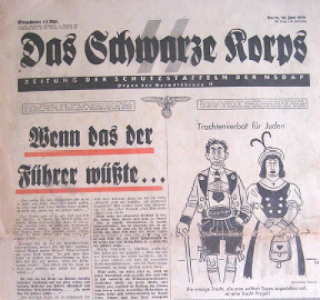
Truly baffling is her inclusion on page 42 of the front page from the SS newspaper Das Schwarze Korps of June 30, 1938. Her caption reads, “In the SS newspaper Das Schwarze Korps (The Black Brigade) sentences like the following could be read: ‘The time should not be too far off when Palestine can welcome again the sons it lost more than a thousand years ago. Our wishes accompany them, with governmental sympathy.’ (May 1935, p. 1).”[23] The caption is remarkable for two reasons. First, the date of the quotation does not match the date of the newspaper page that she chose to include. Second and more importantly, the page that she did include features a grotesque character of a Jewish man and woman, below which a caption reads, “The only costume that this type should be allowed is the costume of a beating!”[24]

Weckert seems unable to contain her loathing for Jews even when noting points in passing. For instance, describing the dislike of Germany felt by many Jews in Palestine in the 1930s, she writes, “Palestine was like the animal that bites the hand that feeds it. The hostility of the Jews toward Germany expressed itself on many different levels. For example, during a Purim procession Germany was depicted as a poisonous-green fire-breathing dragon covered with swastikas…”[25] Jews, we are told, should be thankful to Germany for expelling them to Palestine. Weckert’s treatment of her topic would be comical if not so deeply insulting.

Given this level of contempt for Jews, it is perhaps surprising that a “respectable” concern like HH would include Weckert’s book among its other “scholarly” undertakings. Indeed, her work in general is only rarely cited by other deniers. The notable exception – David Irving’s reliance upon her work on Kristallnacht in his Goebbels biography – led Richard Evans to conclude, “A more blatant disregard for the most elementary rules of historical scholarship would be hard to imagine.”[26] It would be difficult to improve upon that statement with regard to Weckert’s work.


[1] Andrew E. Mathis, “Reichskristallnacht: A Response to Ingrid Weckert,” The Holocaust History Project, https://phdn.org/archives/holocaust-history.org/kristallnacht-weckert/index.html, accessed May 6, 2020.

[2] Ingrid Weckert, Jewish Emigration from the Third Reich, 2nd edition (Uckfield, U.K.: Castle Hill, 2016), 10-11.

[3] Thomas Childers, The Third Reich: A History of Nazi Germany (New York: Simon & Schuster, 2017), 234.

[4] Ibid.

[5] David Cesarani, Final Solution: The Fate of the Jews, 1933-1949 (London: Macmillan, 2016), 74.

[6] Weckert, Emigration, p. 20.

[7] Weckert, Emigration, p. 25.

[8] Ibid.

[9] Edwin Black, The Transfer Agreement: The Dramatic Story of the Pact Between the Third Reich and Jewish Palestine (Washington, D.C.: Dialog Press, 2009), 171-172.

[10] Ibid.

[11] Weckert, Emigration, p. 31.

[12] Tom Segev, The Seventh Million: The Israelis and the Holocaust, translated by Haim Watzman (New York: Henry Holt, 2000), 20.

[13] Weckert, Emigration, p. 41.

[14] Weckert, Emigration, 42.

[15] Francis R. Nicosia, The Third Reich and the Palestine Question (Austin, TX: University of Texas Press, 1985), 160.[16] Weckert, Emigration, 53.

[17] Ibid.

[18] Susanne Heim, “International Refugee Policy and Jewish Immigration under the Shadow of National Socialism,” in Refugees From Nazi Germany and the Liberal European States, edited by Frank Caestecker and Bob Moore (New York: Berghahn, 2010), 35-36.[19] Weckert, Emigration, 68.

[20] Ibid.

[21] Ibid.

[22] Weckert, Emigration, 24.

[23] Weckert, Emigration, 42.

[24] Quoted ibid, translation by author.

[25] Weckert, Emigration, 38-39.

[26] Richard Evans, “David Irving, Hitler, and Holocaust Denial,” expert report filed in Irving v Penguin and Lipstadt (2000), EWHC QB 115, https://www.hdot.org/evans/, paragraph K.11, accessed May 6, 2020.

Review of Reviews: Anderson’s ‘Imagined Communities’

In the introduction to the second edition of Imagined Communities (IC), Benedict Anderson notes the book was published alongside similar studies appearing more or less concurrently, plus additional monographs published over the next few years. Among the most important of these works were Ernest Gellner’s Nations and Nationalism and studies by Anthony Smith, John Breuilly, and others. Consequently, many reviews of IC were comparative. This review of reviews examines four earlier comparative reviews of IC with a more recent retrospective to examine how Anderson’s book has been read in the light of his peers.

Gavin Kitching’s review reads Gellner and Anderson in light of Marx’s critique of nationalism as false consciousness. Assessing the plausibility of the authors’ theories, he criticizes Gellner’s teleology: Gellner argues nationalism is a consequence of industrialization, leaving himself flat-footed when facing counterexamples, particularly anticolonial nationalism. He also finds Gellner undermines himself by deploying a Weberian framework but using Marx’s terminology yet rejecting Marx’s critique of capitalism. Consequently, Gellner “like Max Weber himself in fact, is a much better comparative historian than he is a theoretician.”[1] Conversely, Kitching notes Anderson “concentrates on those dimensions of nationalism which are precisely those about which Gellner’s book tells us least.”[2] His “most brilliant insight”[3] is replacing immortality in heaven with the secularized immortality of national membership, explaining better why people will die for their nation but not their class. Further, tying language standardization to capitalism, Anderson is unafraid to stand in Marx’s shadow, and his theory is better equipped for application beyond Gellner’s European context, like the Americas’ creole nationalisms and Africa and Asia’s anticolonial movements.

Breuilly’s review is a useful comparison of Anderson’s and Gellner’s books, ending with the positioning of his own work among them. He states that each author’s point of departure for his analysis dictates “which situations favour the development of nationalism,” as each general theory necessarily falls somewhat short. Whereas both authors view nationalism as emerging alongside modernity, Gellner’s analysis ties its advent to industrialization; his starting point is therefore “at the level of social structure,”[4] while Anderson’s is “at the level of social consciousness.”[5] Thus, Gellner sets a trap for himself such that his “retreat from industrialism as the major generator of nationalism to industrialism as something nationalists want or nationalism promotes is an indication of the failure of this central argument.”[6] Anderson is arguably more successful in not laying a similar trap, instead focusing on the more pliable concept of representation, although Breuilly criticizes him for not addressing sufficiently the “thorny problem of the lack of congruency between ‘cultural’ and ‘political’ nationalism.”[7]

Ernst’s Haas’s review attempts the bigger task of adding to Gellner and Anderson two additional works: Smith’s Nationalism in the Twentieth Century and Dudley Seers’s Political Economy of Nationalism. He wastes no time differentiating among the texts’ approaches: Anderson’s concern is “manufactured linguistic identity,” Gellner considers nationalism “a distinctly industrial principle of social evolution and social organization,”[8] Seers examines economic aspects of nationalism, and Smith characterizes nationalism as “ideology of solidarity based on preindustrial roots.”[9] The books are united by their use of “conceptual dichotomies”[10] (for instance, denouncing Gaullism as right wing but celebrating anticolonial nationalism), rendering the task of studying nationalism “elephantine.”[11] While it is good that the books comment on nationhood’s illusory nature, Haas criticizes them for failing to consider earlier authors on the topic — particularly Karl Deutsch and Rupert Emerson. Finally, offering his own theory of nationalism and identifying revolutionary and syncretic types, Haas addresses the shortcomings identified in the other four authors’ works.

Like Haas, Gale Stokes adds two texts to Gellner and Anderson: two specialist studies of Eastern European nationalism: Socialism in Galicia by John-Paul Himka; and Nationbuilding and the Politics of Nationalism, an essay collection edited by Andrei Markovits and Frank Sysyn. Like Breuilly, Stokes’s review applies modernization theory, particularly Deutsch’s concept of social mobilization; like Kitching, Stokes is eager to see nationalism studies engage Marx. He congratulates Gellner for his “coherent inversion of the central paradox,”[12] by which nationalism and modernization are contradictory processes. Conversely, he claims Anderson “consciously tr[ies] to create a neo-Marxist explanation”[13][594] for nationalism’s origin and spread. Stokes then reads the other books in light of Anderson’s and Gellner’s theories — a Herculean task for an eight-page review. He asserts the case of Galicia disproves Anderson’s print-capitalism theory and finds Gellner’s argument stronger, while agreeing with earlier reviewers Gellner is overly teleological in detailing nationalism’s emergence alongside industrialization.

The final review is Max Bergholz’s “reappraisal” of IC from 2011, reading Anderson against not only Gellner and Smith but also Eric Hobsbawm and other recent analysts and theoreticians of nationalism. Bergholz notes regarding Hobsbawm, “The influence of Anderson’s emphasis on cognitive perspectives was clear.”[14] He similarly marks Anderson’s influence on monographs by Partha Chatterjee, Alon Confino, Peter Sahlins, and others. Significantly, Bergholz also claims that IC contributed to renewed examination of Ernst Renan’s “What Is a Nation?” As newer scholars have moved Anderson’s paradigm, Bergholz concludes, “These new vistas are being explored today in no small part due to the enduring contribution of” IC.[15]

In conclusion, while these reviews are useful in comparing IC to several other important studies, there is a lack of studies positioning IC against theories specifically designed to refute Anderson. In this regard, the work of Tara Zahra’s essay “Imagined Noncommunities,” with its analysis of “national indifference,” and Azar Gat’s Nations, which examines the supposed primordial nature of nations, are particularly significant.


[1] Gavin Kitching, “Nationalism: The Instrumental Passion,” Capital & Class, 9, no. 1 (1985): 107.

[2] Kitching, “Nationalism,” 107.

[3] Kitching, “Nationalism,” 107.

[4] John Breuilly, “Reflections on Nationalism,” Philosophy of the Social Sciences, 15, no. 1 (1985): 74.

[5] Breuilly, “Reflections,” 75.

[6] Breuilly, “Reflections,” 70.

[7] Breuilly, “Reflections,” 72.

[8] Ernst Haas, “What Is Nationalism, and Why Should We Study It,” International Organization, 40, no. 3 (1986): 707.

[9] Haas, “ What Is Nationalism,” 707.

[10]Haas, “ What Is Nationalism,” 712.

[11] Haas, “ What Is Nationalism,” 712.

[12] Gale Stokes, “How Is Nationalism Related to Capitalism? A Review Article,” Comparative Studies in Society and History, 28, no. 3 (1986): 593.

[13] Gale Stokes, “How Is Nationalism Related to Capitalism,” 594.

[14] Max Bergholz, “Thinking the Nation: Imagined Communities: Reflections on the Origin and Spread of Nationalism, by Benedict Anderson,” American Historical Review, 123, no. 2 (2018): 8.

[15] Bergholz, “Thinking the Nation,” 11.

On Graf’s Russian sources

This week, I’m republishing a piece I wrote last year for Holocaust Controversies blog.

I recently wrote a blog post for our larger Holocaust Handbooks project on Ingrid Weckert’s Jewish Emigration From the Third Reich. In the beginning, I pointed out that Weckert has the closest demonstrable ties to neo-Nazis among the living deniers, with Jürgen Graf a close second. Since writing that post, I had occasion to read Graf’s The Giant With Feet of Clay — his lengthy critique of the work of Raul Hilberg. I wanted to provide this brief post to make a few brief comments on the man generally and one of his sources.

First, Graf is easily the most overtly antisemitic of the Castle Hill/CODOH authors. Given how frequently he has collaborated with Carlo Mattogno — who has comparatively much cleaner hands in this regard — it doesn’t really say much for Mattogno that he apparently regards Graf’s work so highly. Should the accusation arise that this statement amounts to guilt by association — well, yes, it does.

Second, Graf’s writing of history is garbage. He doesn’t understand the basics of source analysis and seems to believe (or at least argues) that eyewitness statements are never reliable. He also shamelessly quote mines, often to suppress information that he must be aware would undermine his own theses. He just plainly doesn’t know what he’s doing most of the time. Mattogno’s writing brings its own set of related — but distinct — problems. But compared to Graf’s solo work, Mattogno should be shortlisted for the Pulitzer. Graf is really that bad.

We’ll be elaborating on these points over the coming weeks. In the meantime, I wanted to describe my pursuit of a source that Graf cites in TGWFOC. Among the more striking claims made by Graf in this opus is buried in a footnote on page 36 of the most recent edition: “Of 531 leading personalities in the Soviet Union in 1920, 447 were Jews, cf. Juri K. Begunov, Tajnye Sily w istorii Rossij [sic],Isdatelstvo Imeni A.S. Syborina, St. Petersburg 1996.” 

It took a bit of work, but I did manage to find a copy of the cited book by Yurij Begunov, about whom, it should be noted, enough has been written to firmly cast him into the group of conspiracy loons. Mina Sodman reported in Searchlight (March 2002) that Begunov was among the attendees of a Holocaust denial “conference” held in Moscow in January 2002; Graf was also in attendence.

Regarding the book and its claim about 447 of 531 “leading personalities” of the USSR being Jewish in 1920 (which, it bears mention, isn’t 1941 and is, therefore, after the conscious Russification of the Soviet leadership undertaken under Stalin and after the Great Purges, in which many, perhaps most, of these leaders were shot), it seems Begunov cribbed his list at least in part from Robert Wilton. Our own Sergey Romanov has already discussed Wilton’s lists in some detail, so I won’t belabor his points.

I’ll add only that, where Begunov has added individuals, he seems to have followed Wilton’s basic rules of both creating people and positions where none previously existed and assuming that any person whose name doesn’t end in -sky, -vich, or -ov must be a Jew, regardless of any other evidence. To be clear, both Russia proper and the Baltic States had large, influential German-speaking populations into the early 20th century who kept their German names. The White Army General P.N. Wrangel is just one prominent example. In addition, Begunov counts several people multiple times in multiple lists, so what the true numbers are of Jews and total people listed in his book are anyone’s guess.

The bottom line is that Graf is a kook’s kook and relied on a real garbage heap of a “study” to make this specific allegation.

Sergey Romanov on Katyn

One of the greatest crimes of the Stalin regime was the execution by the NKVD of the Polish officer corps in the spring of 1940, while the USSR and Nazi Germany were still abiding by their nonaggression pact. The crime was actually discovered by the Nazis during their invasion of the Soviet Union, but when the Soviet emerged victorious at the end of the war, they attempted to pin the crime on the Nazis. It was not until the Gorbachev era that the Soviet government began to acknowledge the truth. However, since then, Russian ultranationalists have continued to attempt to shift blame for Katyn.

My long-term colleague Sergey Romanov has been writing about the topic for years, with more work in progress, so I thought I’d link this week to his work at katynfiles.com. This site is in Russian, but using Google’s machine translation can help you limp through it if you’re willing to invest the time. When more of Sergey’s research appears, I’ll link to that too.

REPOST: Some thoughts on the genetic fallacy and ‘The Bell Curve’

I decided to repost this old blog of mine (lightly edited!) since I spent an hour or so last week attempting to debate its content with a defender of Charles Murray. I think it’s held up fairly well. YMMV. Enjoy.

======

The title is something of a pun.

There’s been a lot of virtual ink spilled of late on Charles Murray’s book (with Richard Herrnstein) The Bell Curve. Sam Harris and Ezra Klein debated the former’s choice to have Murray on his podcast, with opinions contributed along the way by Richard Nisbett, Andrew Sullivan, and others. Of the people participating, Nisbett and especially Klein (the latter a non-expert, like myself) are closest to my own points of view. However, I don’t want to specifically engage the “race-IQ controversy” here so much as comment on Murray’s defense of his sources. 

As I’ve commented before, I spent years debating Holocaust deniers, and it’s probably unsurprising to most that the concentration of antisemites among Holocaust deniers is quite high — the Venn diagram is essentially a perfect circle. Pointing this out to deniers while debating them tended to have a few stock responses: “you dirty Jew”; “I am not antisemitic, but if I were, here’s why I would be”; and “facts can’t be antisemitic.”

I’d like to focus here on this third type of response. On the one hand, there is merit in pointing out that, generally speaking, it is not a fair way to dismiss someone’s argument by pointing out that their sources are tainted in some way. Just because someone is an antisemite doesn’t necessarily means s/he is lying, with one exception — when the topic of his/her statement is Jews. When that’s the case, the charge of a genetic fallacy falls flat because, as a fallacy of irrelevance, it cannot be deployed when the topic is wholly relevant. I.e., on the topic of Jews, one’s feelings about Jews are relevant. 

In the same way, one’s view of race is relevant when the topic is race; more specifically, if the topic is black people, then one’s view of black people and their putative inferiority to whites is also relevant. That said, I don’t know what Charles Murray thinks about black people — I can guess, but it’s actually neither here nor there. However, where his sources are concerned, there can be little doubt. Specifically, I want to discuss the Pioneer Fund. 

Murray himself responds to concerns about the Pioneer Fund in his Afterword to The Bell Curve (I believe added for the first paperback edition, although I’m not positive), specifically Charles Lane’s attack in the New York Review of Books. Murray writes, “Lane also discovered that we cite thirteen scholars who have received funding from the Pioneer Fund, founded and run (he alleged) by men who were Nazi sympathizers, eugenicists, and advocates of white racial superiority”.[1]

That Murray felt it necessary to insert the parenthetical comment that he did is suspect at best. It’s not really in the realm of debate whether Lane’s assessment of the Fund’s founders and directors as Nazi sympathizers (some of them), white racial superiority (many of them), or eugenicists (all of them — it was the very purpose for the Fund’s founding) is true.

Murray continues on the same page, “Never mind that the relationship between the founder of the Pioneer Fund and today’s Pioneer Fund is roughly analogous to that between Henry Ford and today’s Ford Foundation.”[2] This is a strange construction for Murray to use, considering that he’s just cast doubt on whether the founders were as bad as Lane characterized them. Obviously, Henry Ford was a gutter antisemite — the point to which Murray makes reference here — while the Ford Foundation actually pursued civil rights goals in the 1960s and 1970s.

But Murray’s comparison ultimately fails for a few reasons. First, the Ford Motor Company, which Ford founded, and the Ford Foundation, which he cofounded with son Edsel, are two separate entities. The Ford Foundation doesn’t produce cars. In contrast, the Pioneer Fund is a single entity. More importantly, Murray suggests that there is no comparison between Wickliffe Draper, the Fund’s founder, and its directors in 1994. This is a mostly true comparison — Draper was openly racist and antisemitic and a keen admirer of Nazi eugenics; in 1994, the Fund’s director was Marion Parrott, a North Carolina lawyer who maintained a low profile (although it’s probably worth noting that among his closest political associates was Jesse Helms).

However, Murray’s note about the Fund’s directors is less important than the work the fund supported. Among the recipients of Pioneer Fund money under Draper was Nazi Germany’s Office of Racial Policy, specifically for the production of films about Nazi eugenics. Under Parrott, among the Fund’s most important beneficiaries was Roger Pearson.

Pearson is important for two reasons. First, he’s important because he founded the Northern League in 1958. Have a look at some samples of their work online, such as this piece from their circular lionizing the work of Houston Stewart Chamberlain. See the ad in the lower left-hand corner? That’s an ad for Right magazine, whose publisher was Willis Carto. To say Pearson is a fascist would be a wholly defensible statement.

Second, Pearson is important because he is cited in the Bell Curve. Not only is he cited in the Bell Curve, but in Murray’s defense of basing his work on studies published in Mankind Quarterly, he never once mentions that Pearson is the journal’s publisher.

The question is ask oneself at this point is not whether Murray is racist. Again, I don’t know whether he is or not, although I can hypothesize on the basis of circumstantial evidence. Rather, the question to ask is why he wasn’t honest about the Pioneer Fund, Mankind Quarterly, and Roger Pearson when he wrote his Afterword. Someone should ask him.

=====

 [1] Richard J. Hernnstein and Charles Murray, The Bell Curve: Intelligence and Class Structure in American Life (New York: Free Press, 1994), Ebook, p. A.36.

[2] Ibid, pp. A.36-37.

Carlo Mattogno is incompetent

If you know anything about me at all, you know I spent years writing about Holocaust denial and its proponents and debunking their claims. Here is one of the more recent series I wrote — this one on Carlo Mattogno, the great white hope of denial or, if you prefer, last man standing. These four posts at hosted at the Holocaust Controversies blog.

Mattogno on Riga
Part I: Keine Liquidierung Revisited
Part II: Phone Calls in Riga, Prague, and Berlin
Part III: Hierarchies Are Hard
Part IV: Polishing a Turd

Update and interview with Brooksy

For those of you (anyone?) regularly reading this blog, just a quick note that I’ve enrolled in the Master of Arts program in history at the University of Pennsylvania and am taking two courses this year that together constitute an introduction to the proper conduct of historical research. Both because much of the writing for the course does not come until later and because of the personal nature of much of that writing, I don’t expect to be sharing much of it here. Instead, I’ll link on a weekly basis to things I’ve written elsewhere, so please keep a watch for those posts. In addition, when appropriate, I’ll share coursework from Penn here too.

For this week, here’s an interview I did a couple of years ago with the late, great Michael Brooks. RIP Michael.

Technology and historians

The development and advance of technology has greatly affected the work of historians. On the one hand, the work of historians has been made considerably easier with the movement online of several important archival sources, rendering travel in some cases unnecessary, with more sources coming online all the time. My own project in this course was affected by this increased availability, as was likely the case with several other students in this class. On the other hand, certain challenges have emerged as a result of this increased technology. According to Dan Cohen, “As more documents are scanned and go online, many works of historical scholarship will be exposed as flimsy and haphazard”[1] as a result of the “anecdotal history” of previous generations. Such a development could render useless many secondary sources that has been commonly consulted in the past. This development, of course, could end up being a boon as it would open old inquiries to new investigations.

From an ethical standpoint, a major issue that has emerged with increasing technology is the future status of intellectual property. An interesting twist on this issue is cited by Roy Rozenzweig in his discussion of volunteer researchers. Rozenzweig notes that many people are willing to volunteer to gather information for research projects ranging from surveying the craters of Mars to placing 19th century women’s diaries online. “But,” he asks, “are they also willing to take the further step of abandoning individual credit and individual ownership of intellectual property as do Wikipedia authors?”[2] The problems would compound further were the content generated by volunteers monetized at some later point. Ultimately, the legal and ethical issues evoked by the “crowdsourcing” model of Internet content creation as it affects the study of history might only be resolved within the larger context of Facebook’s or Twitter’s right to exploit user data or an overhauling of intellectual property law.

Regarding the idea of “fragmented history,” John Tosh characterizes the phenomenon as follows: “history has become a discipline with very little apparent coherence.”[3] This point seems to be one that is distinct from the issue of the development and advancement of technology and instead is more closely related to the proliferation of “schools” or “lenses” of history. Interestingly, I have worked in STEM publishing for several years and have seen this kind of crossover happening within scientific fields. For instance, while biomedical engineering and electrical engineering were once distinct fields, there is now significant overlap between the fields, such as electrical engineers being involved in the creation of neurological devices for biomedical purposes. This bleeding of the edges, while giving rise to turf wars here and there, has also benefitted the overall field of engineering tremendously. I think a similarly positive outcome for history is also possible provided the turf wars are controlled. Rather than defending our work like territory, we should welcome inquiries from other fields as a way of keeping us on our toes.

======

[1] Dan Cohen, “Is Google Good for History,” Dan Cohen’s website, accessed August 18, 2020, http://dancohen.org/2010/01/07/is-google-good-for-history/

[2] Roy Rozenzweig, “Can History Be Open Source? Wikipedia and the Future of the Past“, Journal of American History, 93, no. 1 (2006): 145.

[3] John Tosh, The Pursuit of History: Aims, Methods, and New Directions in the Study of History, 6th ed. (New York: Taylor & Francis, 2015),  370.Reply to Thread

Design a site like this with WordPress.com
Get started