Red Victory in the Russian Civil War

It would be disastrously reductive to assume that any single factor contributed more than any other to the Red Army winning the Russian Civil War. Different historians with different ideologies will necessarily take different views regarding this question. However, if the war was most bitterly fought and for the longest time in the westernmost reaches of the Russian Empire, particularly in Ukraine and Poland, then ultimately I think a combination of military, ethnic, and terroristic factors contributed most to Soviet victory.

On the first point, the textbook makes the point well that fighting on widely separated fronts made it difficult for the White Armies to mount offensives with long-term results.[1] On the other side of the battlefield(s), that the Soviets were encircled within the great Russian heartland actually facilitated a more successful defense earlier in the war, with a smaller, constrained theater of operations allowing for greater maneuverability. As M.K. Dziewanowski points out, many Red Army veterans were deployed several times.[2]

Related to this first point is the second point of ethnic factors. Again, as noted in the textbook, the White Army generals, being generally insensitive to the feelings and concerns of non-Russian ethnic groups, lost vital support as a result of vocally assuring Russian supremacy in the event of a White victory.[3] Given the importance of the most ethnically diverse areas of the Empire to a White victory, such rhetoric was a crucial mistake, although it bears mentioning here that the Soviets did not have anything better to offer non-Russians besides the notion of an end to repression as the result of a society rid of religious and ethnic division on the basis of socialism.

Finally, the use of terror was important to both sides, although with different end results. On the one hand, the infliction of ethnic violence by White Armies, particularly in the form of pogroms against Jews residing in the old Pale of Settlement, guaranteed that the sympathies of some minorities would fall to the Bolsheviks, at least in the short term.[4] On the other hand, the pervasive use of terror by the Red Army no doubt played a role in obtaining compliance from the population at large in areas under its control.

Regarding the factors emphasized by different schools of thought, totalitarians have typically been fond of emphasizing the Red Terror as a key factor in Soviet victory. Given the totalitarian emphasis on the most negative aspects of Soviet rule, not to mention Daniel Pipes’s de-emphasis of the agency of workers and peasants in the rise of Soviet rule,[5] it is unsurprising that this extremely negative policy of the Red Army should receive attention, although it bears mention that the Soviets were not alone in employing terror. In contrast, being far more likely to consider workers and peasants as fundamentally important actors in the revolutionary process, the revisionists are more likely to emphasize economic matters, making the argument that the Soviets’ promise of economic equality motivated and mobilized support for the Red Army. Again, the truth likely lies somewhere between these beliefs.

=====

[1] M.K. Dziewanowski, Russia in the Twentieth Century, 6th ed. (Upper Saddle River, N.J.: Pearson, 2003), 107-08.
[2] Ibid, 114.
[3] Ibid, 108.
[4] The YIVO Encyclopedia of Jews in Eastern Europe, online edition, s.v. “Russian Civil war,” accessed April 21, 2016,http://www.yivoencyclopedia.org/article.aspx/russian_civil_war, para. 3 ff.
[5] Richard Pipes, “Reflections on the Russian Revolution,” Alexander Palace Time Machine, accessed April 10, 2016,http://www.alexanderpalace.org/palace/pipesrevolution.html, paras. 13 and 14.

Source Analysis: Lenin’s Rise to Power

That V.I. Lenin left behind volumes of his own writings is helpful in determining his justifications for his historic actions. For example, two of his essays, “The Tasks of the Proletariat in the Present Revolution,” from April 1917, also known as the “April Theses,”[1]and “Theses on the Constituent Assembly”[2] from six months later, help to determine Lenin’s thinking in the period from the March Revolution that removed the tsar and established a parliamentary republic and the Bolshevik seizure of power in November. By examining the two texts in juxtaposition with each other, it is possible to determine the reasons for Lenin’s decision to embrace extremism by eliminating parliamentary democracy during the first few months of Soviet rule, including the continuing war, the difficulties inherent in minority status, and his observations of the Marxist theory of revolution unfolding at an expedited pace.
In the “April Thesis,” Lenin writes, “I attacked the Provisional Government for not having appointed an early date or any date at all, for the convocation of the Constituent Assembly, and for confining itself to promises.”[3]He goes on to remind his reader that he merely argued that such an assembly would not work in the absence of workers’ councils (i.e., Soviets) to represent workers and soldiers. In offering his argument for such a position, the first topic he broaches is the ongoing war against the Central Powers. In Lenin’s view, the continuation of the “predatory imperialist war”[4] was being undertaken the provisional government. Because the parties that would participate in elections to the Constituent Assembly would be bourgeois parties, Lenin emphasizes the need to counterbalance the assembly with Soviets that represent the proletariat.
However, once the Bolsheviks have seized power and he promulgates his “Theses on the Constituent Assembly,” Lenin is satisfied to nullify the results of the election to the Constituent Assembly, arguing, “Only now are the broad sections of the people actually receiving a chance fully and openly to observe the policy of revolutionary struggle for peace and to study its results.”[5] Because the “mass of the people” did not realize this possibility at the time of the elections, he argues, the Bolsheviks must be given the opportunity to express the will of the people. In explaining Lenin’s point of view, Orlando Figes seizes on Point 13 of the “Theses on the Constituent Assembly,” which argues that the October Revolution had “shifted mass opinion to the left since the election.”[6]Ironically, the Bolsheviks would resort to using force to impose this “mass opinion.”
Lenin also argued at first for the combined presence of a Constituent Assembly and People’s Soviets in recognition that the Bolsheviks were a minority party, even within the Soviets themselves. In the “April Theses,” he writes, “in most of the Soviets of Workers’ Deputies our Party is in a minority, so far a small minority, as against a bloc of all the petty-bourgeois opportunist elements.”[7] He concedes that, as a minority, the Bolsheviks must focus their efforts on propagandizing the working class “so that the people may overcome their mistakes by experience.”[8] All the while, Lenin makes it clear in the “April Theses” that the long-term goal would not be a parliamentary democracy but a Soviet republic.
Once he had seized power, however, Lenin was happy to impose minority rule. Robert Mayer writes that, at least in part, Lenin was willing to take revolutionary action only once the Bolsheviks had gained majority control over the soviets in Petrograd and Moscow. He “claimed a majority mandate within the proletariat for the October Revolution, and he justified Bolshevik rule thereafter on [that] basis.”[9] To Mayer, this decision amounts to a rejection of previous denunciations by Lenin of Blanquism,[10]at least on a national level, as well as the expression of his willingness to impose a Tocqueville-esque “tyranny of the majority” on the Soviets themselves.[11]
Finally, in accepting the calls for a Constituent Assembly in the “April Theses,” Lenin seems to embrace the orthodox Marxist notion of a two-stage revolution, according to which a bourgeois-democratic revolution must precede the proletarian revolution that seizes power for the working classes. In the “Theses on the Constituent Assembly,” however, Lenin argues that the bourgeois-democratic state must be smashed a mere six months into its life cycle and mere weeks after elections to its parliament. To many readers, this shift represents the greatest transformation in Lenin’s thinking, if not outright hypocrisy.
Jonathan Frankel has argued, however, that assuming a radical shift in theory or hypocrisy on Lenin’s part is too hasty. Rather, at least from Lenin’s other writings, Frankel summarizes Lenin’s view as one that “the revolution had gone much farther than anticipated and control of the state had already passed from the feudal to the bourgeois class (in the form of the Provisional Government.”[12] In short, even before elections to the Constituent Assembly had been called, Russia had already achieved bourgeois-democratic status. Once “the actual power of the Soviets was so immense that they in fact constituted (albeit in passive form) the long-awaited dictatorship of the proletariat and peasantry,”[13] presumably on the basis of Bolshevik majorities, at least in Petrograd and Moscow, it would be a betrayal of the revolution to revert to a parliamentary state.
In conclusion, reading the two sets of theses by Lenin provides an opportunity for insight into his decisions during 1917. The continuation of World War I by the Provisional Government was a major reason for Lenin’s rejection thereof, and he feared the Bolsheviks had not been able to mobilize public opinion against the war before the elections to the Constituent Assembly occurred. Moreover, the Bolsheviks remains a minority party throughout 1917, despite gains in the Petrograd and Moscow Soviets. Although Lenin’s decision to dismiss the Constituent Assembly and establish a Soviet dictatorship can appear hypocritical, it was also the pace of events over the course of the year that large affected his change in tactics.


Bibliography
Figes, Orlando. Revolutionary Russia. Accessed April 15, 2016. http://www.            revolutionaryrussia.com/
Frankel, Jonathan. “Lenin’s Doctrinal Revolution of April 1917.” Contemporary History,
            4, no. 2 (1969): 117-142.
Lenin, V.I. “The Tasks of the Proletariat in the Present Revolution.” Translated by Isaacs
Bernard. Accessed April 15, 2016. https://www.marxists.org/archive/lenin/works/
1917/apr/04.htm
Lenin, V.I. “Theses on the Constituent Assembly.” Translated by Yuri Sdobnikov and
George Hanna. Accessed April 15, 2016. https://www.marxists.org/archive/lenin/
works/1917/dec/11a.htm
Mayer, Robert. “Lenin, the Proletariat, and the Legitimation of Dictatorship.” Journal of
            Political Ideologies, 2, no. 1 (1997): 99-115. doi: 10.1080/13569319708420752.


[1] V.I. Lenin, “The Tasks of the Proletariat in the Present Revolution,” trans. Isaacs Bernard, accessed April 15, 2016, https://www.marxists.org/archive/lenin/works/1917/apr/04.htm
[2] V.I. Lenin, “Theses on the Constituent Assembly,” trans. Yuri Sdobnikov and George Hanna, accessed April 15, 2016, https://www.marxists.org/archive/lenin/works/1917/dec/11a.htm
[3] Lenin, “Tasks,” point 10, para. 9.
[4] Ibid, point 1, para. 1.
[5] Lenin, “Theses,” point 15, para. 2.
[6] Orlando Figes, “Section 6: The October Revolution 1917,” Revolutionary Russia, accessed April 15, 2016, http://www.revolutionaryrussia.com/section6_TheOctoberRevolution1917/TheConstituentAssembly.php, para. 5.
[7] Lenin, “Tasks,” point 4, para. 1.
[8] Ibid, point 4, para. 3.
[9] Robert Mayer, “Lenin, the Proletariat, and the Legitimation of Dictatorship,” Journal of Political Ideologies, 2, no. 1 (1997): para. 18, doi: 10.1080/13569319708420752
[10] Ibid, para. 17.
[11] Ibid, para. 15.
[12] Jonathan Frankel, “Lenin’s Doctrinal Revolution of April 1917,” Contemporary History, 4, no. 2 (1969): 127.
[13] Ibid.

Russian Historiography: Totalitarianism vs Revisionism

Back to school! Here’s my first discussion post for my Modern Russia class.

====

Having read the textbook chapters for the week and the readings by Alice Gomstyn and Richard Pipes, as well as having very recently read J. Arch Getty‘s two books on the Great Purges, I have come to the conclusion that both the totalitarian and revisionist schools of thought on Soviet history have strengths, but they are both more characterized by weaknesses. Like many cases in which schools of thought operate at odds with each other, it is more likely that the truth lies somewhere between their respective versions.
The chief strength of the totalitarian school is its authority. As the older of the two schools, it benefits from the greater longevity of the narrative that it has established. Its primary weakness, in my opinion, is that it owes too much to the “Great Man” theory of history of Thomas Carlyle,[1] with the man in question in this case being Stalin. While it is attractive to see Stalin as exercising complete control over the fate of the Soviet Union during his rule, it is also likely overly simplistic. The chief strength of the revisionist school is its recognition of the contributions of complex forces in the unfolding of historical events. Its primary weakness, perhaps unsurprisingly, is the extent to which it de-emphasizes Stalin’s historical role, highlighting instead the contributions of regional party leaders and local elites in processes of repression, for instance.
Those things said, there does remain some relevance for both schools of thought. For instance, the totalitarians have been largely vindicated by the publication of the Venona project decrypts having revealed the extent of Soviet espionage. Additionally, as Gomstyn points out, much of the material from the archives has largely their suspicions that repression in the USSR was widespread and deeply resented by the people. The totalitarian viewpoint thus remains valid for largely moral reasons, although as Gomstyn also notes, this moralizing can be reductive, e.g., the labeling of Getty by Martin Malia as engaging in a form of denial.[2] In contrast, the emphasis by the revisionists of Soviet scientific achievement, avoids throwing out the baby with the bath water, so to speak, although it does run firmly up against the totalitarian view that the ends do not justify the means. Thus, the revisionist viewpoint remains relevant in part for the same reason why we do not avoid building divided highways, although it was the Nazis that introduced them.
Regarding the article by Pipes, it become clear relatively early in reading it that he comes from the totalitarian school. He chalks up the weaknesses of Nicholas II’s reign to the tsar’s inability to adjust to the economic growth of the country and the social changes they wrought.[3] In emphasizing the tsar’s role in his own downfall, Pipes simultaneously de-emphasizes the role of the people, choosing instead to hang blame on a radical intelligentsia and a peasantry unable and unwilling to adapt to industrialization. In this way, Pipes evokes a “great man” theory based on Nicholas II, while dismissing or denying more complex social-historical forces.
The counter-arguments against Pipes are offered at least in part in the textbook. For instance, Dziewanowski is able to substantiate the claim of an angry and alienated peasantry by emphasizing, as Pipes does not, that with emancipation of the serfs came a series of new problems not the least of which was binding them to the village commune and to land captains. While Pipes is satisfied to dismiss the peasants’ desire for further reforms are greed for land,[5] Dziewanowski is more willing to entertain a more nuanced interpretation of the peasants’ situation that fueled their concerns. While I do not whether Dziewanowski would consider herself a revisionist, it is clear, at least from this week’s readings, that she is not a totalitarian.
—–
   [1] Thomas Carlyle, On Heroes, Hero-Worship, and the Heroic in History (London: Chapman and Hall, 1840),https://books.google.com/books?id=kCo-AAAAYAAJ
   [2] Alice Gomstyn, “Where the Cold War Still Rages,” Chronicle of Higher Education 50, no. 22 (2004): para. 7,http://search.proquest.com.ezproxy.snhu.edu/docview/214684560?accountid=3783
   [3] Richard Pipes, “Reflections on the Russian Revolution,” Alexander Palace Time Machine, accessed April 10, 2016,http://www.alexanderpalace.org/palace/pipesrevolution.html, para. 23.
   [4] M.K. Dziewanowski, Russia in the Twentieth Century, 6th ed. (Upper Saddle River, N.J.: Pearson, 2003), 43-44.
   [5] Pipes, ibid, para. 10.

Appeal to All Members of the KPR(b)

What appears below is my translation from German of a translation from Russian of the so-called Ryutin Appeal, which is essentially a condensed version of the Ryutin Platform of two years earlier. Given that it’s a translation of a translation, all the standard caveats apply.

The source is: Annette Vogt, “Eine bestechende Analyse, eine fundierte Kritik, aber … — die Tragik des Martemjan Nikititsch Rjutin,” in Ketzer im Kommunismus: 23 biographische Essays, eds. Theodor Bergmann and Maria Kessler (Hamburg: VSA Verlag, 2000), 140-61.

To all members of the Communist Party of Russia (Bolsheviks) [KPR(b)]

Comrades!
The party and proletarian dictatorship have been led by Stalin and his clique into an impasse of the worst possible extent, and they are currently experiencing a deadly dangerous crisis. With the help of misdirection, slander, and duping of party members, with the help of extraordinary force and terror, flying the flag of struggle and of purity of Bolshevik principles and party unity, based on a powerful, centralized party apparatus, Stalin has over the last five years removed from leadership and isolated the best and most sincere Bolshevik cadres. He has, in the KPR(b) and in the whole country established a person dictatorship, broken with Leninism, and gone on a course of unbridled adventurism and wild personal despotism. Therewith he has driven the Soviet Union to the brink of disaster.

If in the first decade of Soviet power, under the collective leadership of the Central Committee and the entire party of the working class under the heroic efforts of their powers, could undertake the greatest achievements in the issue of the development of socialist organization, the improvement of all working people and the consolidation of proletarian dictatorship, so it was the opposite that Stalin worsened the situation in the Soviet Union with every year systemically and at a rapid pace. Chaos and disorganization of the economy of the country, regardless of the establishment of a dozen major enterprises, assumed an unprecedented level. The faith of the masses in the cause of socialism was undermined, their preparedness, selfless defending the proletariat revolution against all enemies, weakens from year to year.

The pace of industrialization brings a colossal reduction in the wages of laborers and workers, unsustainably high overt and covert taxes, inflation, price increases and the deflation of the ruble with it. The means of incredible acts of violence and terror aimed at collectivization and de-kulakization, primarily targeting the masses of rural small and medium-size farmers, and at long last leading, with expropriation of villages by any means necessary and compulsory levies on the whole country, to the deepest crisis to date. It has led in the village, as in the cities, to egregious impoverishment of the masses and to starvation.

Industry works with only half the capacity of the machines and also to significant extent with surrogates (substitutes). The result of the quest to meet the exaggeratedly fast pace is an extraordinarily low quality of the products. The labor productivity of hungry workers have fallen sharply. In the country, the wages might not be paid for a few months, it is difficult to squeeze taxes from the impoverished population; reduction of the numbers of laborers and workers began. Before the proletariat lies the specter of approaching massive unemployment of the fullest extent; the raw materials base is essentially undermined.

Perspective threatens further paralysis of industry and shrinking of capital construction, as well as the deterioration of the financial resources of industry with each passing day. In the future, it will come to further impoverishment of the proletariat and an increase in hunger.

Even gloomier and more complicated is the picture in the villages. The plunder of the rural population and the forced collectivization lead to not more than 30% of the livestock remaining from 1927, of which the remainder, in the kolkhozes and sovkhozes, will also die because of the food shortage. New rural establishments cannot be built or the older ones conserved, and a large number are being plundered. The agricultural inventory has been smashed and destroyed. The farmers have only half the seeds they need, the soil is bad and frequently not worked at all; there are not enough draft animals.

Any personal interest in the management of agriculture is smashed, the work is only be carried out through force and pressure, forcibly created kolkhozes are destroyed. All youth and health flees the village, millions of people, who have been turned away from production activities, roam through the country, the cities flood. The population remaining on the land is hungry and eats substitutes.

Epidemics begin to spread. There will be in the future in the country a further impoverishment, destitution and migration. In the coming year, the greatest famine yet threatens.

Domestic trade finds itself as well in chaotic condition: the ruble is worthless, the unprincipled price policy changes hands helplessly; the prices increase. On the basis of missing goods, hunger and disruption of the country’s economy drives speculation in all regions and rampant counterfeiting.

The foreign trade balance has an enormous deficit; exports are basically undermined and indeed are only maintained at the expense of the impoverishment of the masses. The plan policy has generally transformed into swindles and deceit; everywhere yawn unpaid debts, for which the Stalinist leadership makes the employees responsible; the plans are only 60 to 70 percent fulfilled, the possibility of forward movement and controllability of the economy approaches zero. The rural economy is disorganized, and any possibility of development has been left to the power of elemental forces.

At the same time, at the 17th All Union Party Conference of the Stalinistofficials, the party, the proletariat and all working people are shamelessly and cynically mocked, it is explained, that we have reached the stage of socialist society and that “with us, the national incomes of the capitalist states are growing at an uncontrollably fast pace, unemployment and poverty are eliminated, the ‘price cuts’ as well as the distinction between city and country is disappearing, from year to year the prosperity and the cultural level of the workers and toiling peasants are growing.”

The whole country is muzzled, injustice, despotism, and violence hover as a permanent danger over the head of every worker and farmer. Any revolutionary justification is trampled! Any belief in tomorrow will be lost! The working class and the working people of the country are driven to the brink of despair by the Stalinist policies.

Hatred, malice, and disgust of the masses cooks and seethes under the firmly bolted lid of terror. The rebellion of the farmers, among them the party members and Komsomol, poured in past years in unstoppable waves over the whole Soviet Union. Worker strikes, regardless of the raging terror, arrests, dismissals, and provocations, burn sometimes here, sometimes there.

***

The teachings of Marx and Lenin are shamelessly distorted and falsified under Stalin and his clique. Science, literature, art have been reduced the level of a lower servant and prop of the Stalinist leadership. The struggle against opportunism is trivialized and turned into a caricature, by means of slander and terror, and proceeds against the independently thinking party members. The rights of the party are usurped by a tiny clique of unprincipled politicians. Democratic centralism are exchanged for the personal discretion of the leader and the collective leadership and for a system of representatives. The Central Committee becomes the advisory body to an “infallible” dictator, the regional committees appendages without rights, under the management of regional party secretaries. The Politburo, the central committee of the Komsomol, the secretariat of the regional committees transform as the result of changes in party life and “Stalin’s 18th of Brumaire” into a gang of unprincipled, mendacious, and cowardly politicians. Stalin, however, transforms into an unrestricted and irremovable dictator — compared with any arbitrary absolute monarch — which comes in his ten times more mindless arbitrariness, his despotism, and his criminal violence exerted on the masses.

Through the system of threats, terror, and fraud, the party is forced into the role of a mute, blind tool of Stalin to achieve his personally ambitious plans. The masses of party members are set in the overwhelming majority against the Stalinist policies; however, the party apparatus is used to intimidate and incite them.Every lively Bolshevik party idea is threatened through exclusion from the party threatened, as well as strangled with dismissal from work and withdrawal of all necessarily existing means. All Leninist ideas are driven underground, unadulterated pure Leninism has been significantly affected by prohibition, thus becoming illegal ideology. The party apparatus transforms itself, in cycles of development of inner party struggles and the expulsion of one leading group after another, into a self-sufficient power standing above the party and ruling over it, with conscious and violently oppressive will. In the area of party work dominate instead of the most confident, most honest, most true to principles, instead of those who are ready to defend anybody and everybody and their views to defensive, dishonest, cunning, unprincipled party members, who are ready, on order of the leadership, a dozen times to change their convictions — careerists, submissives, toadies.

The appearance and essence of proletarian dictatorship are falsified. The workers councils are lately repurposed as a miserable appendage of the party apparatus, from which the nearby masses and related organs an unscrupulously bureaucratic machine was created. The unions, schools of communism in which the workers continue their education, in the spirit of a conscious relationship with the socialist enterprise and to achieve the defense of corruption and, at the same time, must defend the bureaucratic corruption of the worker state, are turned into an auxiliary organ that the places the workers under duress and penalizes dissenters.

The press, the enormous instrument of communist education and weapon of Leninism becomes, in the hands of Stalin and his clique, an insane factory of lies, deception, and terrorization of the masses.

The anti-Leninist policies of the party leadership is supplemented by an anti-Leninist leadership of the Communist International. The Comintern, the staff of world revolution, becomes a primitive office of Stalin’s, in which cowardly officials sit, who, obedient to the will of their leaders, carry out the affairs of that communist parties are not qualified to handle. The crisis of the KPR(b) leads to the crisis of the Comintern. All communist parties, except for the German party, are not larger but smaller. Their influence decreases, as the examples of the election to the English Parliament and the Reichstag election in Germany show. The central committees of the communist parties are forced to lie to the masses regarding the factual situation in the KPR(b), as well as the situation in the Soviet Union over all. This deceit, which comes to light in this or that way, brings schism and disappointment to the masses.

The unprincipled, adventurist policies within the USSR are lately also accompanied by unprincipled sleight-of-hand in solving international problems. The position of the KPR(b) and the Comintern regarding the behavior of Japan in Manchuria and Shanghai was obviouslymarked by opportunism. Regarding the currently growing threat of war, there are no suitable means to bring about a mobilization of the awareness of the masses to the solution of this problem. The apparat-implemented measures and restrictions evoke a senses of disappointment among the workers. For Stalin and his clique, it no longer possible to return to the true Leninist path, for them there is no way out, they are hopelessly entangled in lies and have run into an impasse. They furthermore waver helplessly from side to side and are always more entangled and otherwise confused, they do not allow the will of the party to be exercised, further complicating and aggravating the situation. They defend their rule over the party and country with lies and deception, executions and arrests, guns and rifles, with all possibilities and means, because they consider all of this their domain. Objectively considered, Stalin’s role is that of Azef to the party and proletarian dictatorship and socialist organization are equated. Not even the most daring and ingenious provocateur, who worked for the end of proletarian dictatorship and the discrediting of Leninism, could have worked out better than the leadership under Stalin and his clique.

The masses of the party and the labor force are obliged to salvage the cause of Bolshevism, they are obliged to take their fate into their own hands. Stalin and his clique will not yield and will not leave their offices by their own free will; therefore, they must be eliminated with all available force. It would be shameful and disgraceful for the proletarian revolutionaries to endure further the Stalinist yoke, his arbitrariness and mockery of the party and the toiling masses. Whoever does not recognize this yoke and does not feel this despotism and the urgency, in whom no outrage is triggered, make themselves into slaves and not into Leninists; into serfs and not into revolutionaries.

We, the members of the KPR(b), who have come together at this All Union Conference, have decided to fight against Stalinism, to restore the rights of the party and proletarian dictatorship, to return the party to the proven Leninist course of socialist organization, to found a “Union of Marxist-Leninists.” This “union,” a union for the defense of Leninism, part of the KPR(b), has no intention to split off from the interests of the party masses and the working class. On the contrary, it will more consistently and energetically express and defend those interests. It is not against the party, only Stalin and his clique.

The “Union of Marxist-Leninists” represents the viewpoint of urgent and systematic development of the industrialization of the country, on the basis of an actual improvement in the material situation of the proletariat and the working people. Currently, its concerns itself primarily with the task of fighting implacably against the methods and the pace of industrialization,upon which the desolation, misery, and famine of the whole country is based. Because this industrialization is not truly socialist and accordingly cannot lead to a socialist society.

The “Union of Marxist-Leninists” represents the intention that the efforts of all of the powers for truly voluntary collectivization by simultaneously systematic support of the development of the industrial-scale organization of poor and middle-class peasant economy must be enforced. Immediately, however, it has as its primary goal to fight against the violent Stalinist collectivization because it contradicts the program of the party and the Comintern and so is suffering a complete bankruptcy.

The “Union of Marxists-Leninists” represents the viewpoint of the incompatibility of class interests between the proletariat and the capitalist elements on behalf of the USSR. The Union is firmly opposed to the cover-up of class contradictions between the working-class masses in the city and country, but it currently faces the task of systematically and dispassionately leading the fight against the anti-Leninist character of the unleashing of class struggle and civil war under the conditions of proletariat dictatorship. Because such a wildfire usurps and disorganizes the worker state and socialist organization.

The “Union of Marxists-Leninists” will resist any opportunist appearance as an enemy, but it is the currently the chief task to proceed unsparingly against the Stalinist trivialization of Leninist teachings about the struggle against opportunism and their transformation into a caricature with the help of deception, lies, and terror, because it discredits Leninism, demoralizes the party, strengthens and increases opportunism.

To achieve the above tasks, everyone must defend Bolshevism, everyone must experience Leninism, everyone must coordinate righteous proletarian revolution. In the light of the events we have experienced, the old inner-party groupings behave hopelessly and lose their importance. History has not asked us the question of the examination of this or that mistake or nuances in understanding individual problems of Leninism, only the existence of the Bolshevik party and the worker state itself. The dividing line in the party today runs not along the line of “for or against Trotsky,” “for or against Bukharin,” only for the continuation of the Stalinist leadership and the inexorable case of the Leninist party and Soviet power, or for the liquidation of Stalinism, the salvation of the KPR(b) and proletarian dictatorship. The concern of Lenin regarding the disloyalty, dishonesty, and unreliability of Stalin, his incompetence to use power has materialized entirely and completely: Stalin and his clique smother the cause of communism, Stalin’s leadership must be ended as quickly as possible.

We call on all sincere Leninists everywhere to organize cells of a union in defense of Leninism and to band together under its flag to liquidate the Stalinist dictatorship.

Get to work immediately! It’s time to finish with the state of confusion and fear of reprisals of the brazen, unprincipled politicians and traitors to the cause of Leninism, to end the feeble grousing and grumbling and to begin the selfless struggle. It is pointless to await the beginning of the battle from above, it must begin from below. Bravery and commitment to the great legitimacy of our cause is to oppose terror. Every party member who holds dear the achievements of October and the cause of socialism must, as an organizing core, must unite around himself devoted, honest, hopeful comrades. Every Leninist must everywhere possible, in the shortest possible time, address the challenges propagating before us because events do not wait. Our main slogan must passed on from comrade to comrade, from group to group, from city to city: Away with the dictatorship of Stalin and his clique, away with the gangs of unprincipled politicians and political con men! Away with the usurper of the rights of the party! Long live the KPR(b)! Love live Leninism!

All-Union Conference of “Union of Marxist-Leninists”
June 1932
Read, pass on. Duplicate and share.

Translation of appeal by A. Vogt. Reprinted in: M.N. Ryutin, Na koleni ne vstanu. Moscow 1992, S. 252-259.

Agenda for February and March

Through a variety of approaches, including CLEP (American History II), AP credit from high school (American History I), a course transferred from a local community college (World History II), and three courses online at SNHU (World History I, Modern War and Society, and Making History), I have completed half of the courses in the history major at SNHU, with six more to go. Since I intend to focus on 20th century Europe, the courses I have left to take are courses on World Wars I and II, Modern Europe 1890 to Present, and Modern Russia. The final two courses are a thesis-writing course and an elective — right now, I’m thinking I’ll take a graduate-level research course for the elective, but that’s a year away now.

My tuition remission perq requires that I take no more than four courses per year (unless I pay for them). So as not to violate that limit, I cannot take a course again until April 11, when I intend to take the course on Modern Russia. In preparation for that course, in which I intend to focus on the Great Purges, I have been reading fairly broadly in that area, including Conquest’s The Great Terror and now on to J. Arch Getty’s Origins of the Great Purges and a relatively recently published translation of the Ryutin Platform. More on that topic as my ideas develop.

Finally, I’ll be spending the next few weeks writing up some material from the Nazi occupation of Latvia and the liquidation of the Jewish ghetto established at Riga in November and December 1941, the subject of some controversy in the historical community. I will post that material both here and at Holocaust Controversies, hopefully in the next few days.

Other Stuff I’m Reading
Universal Fascism: The Theory and Practice of the Fascist International, Michael Ledeen
The Anatomy of Fascism, Robert O. Paxton

Meritocracy: A Mongol Innovation

Of the many innovations introduced to other parts of the world by the Mongols, as they invaded neighboring regions and established their empire, meritocracy is among those with the greatest impact over time. Meritocracy, quite simply, is defined as “a system in which the talented are chosen and moved ahead on the basis of their achievement.”[1] Before the rise of meritocracy, advancement in positions, whether military, political, or economic, was based on nepotism or personal favoritism. With the Mongol concept of meritocracy, family ties were overridden by advancement based on proven ability.[2]

Arguably, this attention to merit rather than bloodlines was among the decisive factors rendering the Mongols so efficient and fearsome on a military basis. The Han Chinese general Guo Kan offers a paradigmatic example. Guo Kan, despite being a member of an army that resisted the Mongols, was promoted under Kublai Khan and assisted the Mongols in subsequent victories. For instance, in describing the Mongol victory over the Abbasid Dynasty, historian Frank McLynn writes that Guo Kan was “at 40 the same age as Hülegü [grandson of Genghis Khan] and already renowned as an example of the way Mongols promoted on merit rather than birth.”[3]

The idea that position should be determined by merit and not by birth continues to the present day. Our own U.S. military promotes on that basis, for instance, as do virtually all other militaries. And while nepotism might remain an issue in some sectors, it has nevertheless become axiomatic that hard work pays off and that the best way to the top is through one’s hardest effort.
=====
1. Merriam-Webster Dictionary, “meritocracy,” accessed January 14, 2016, http://www.merriam-webster.com/dictionary/meritocracy
2. Paula L. W. Sabloff, Modern Mongolia: Reclaiming Genghis Khan (Philadelphia: University of Pennsylvania Press, 2001), 99-100.
3. Frank McLynn, “Mongols at the Gate,” Military History, 32 (September 2015): 41.

Term Paper: Arab Rule in Sicily

By 732 CE, the armies of the Umayyad Caliphate, with their conquest of the Iberian Peninsula well under way, had crossed the Pyrenees only to be defeated in France by Charles Martel at the Battle of Tours. With only 250 kilometers between Carthage in North Africa and the western Sicilian city of Trapani and just eight kilometers from Messina on the northeast corner of Sicily to Reggio di Calabria on the toe of Italy’s boot, it might seem that Sicily would be the ideal route through which Muslim armies from Ifriqiya could attack what Winston Churchill once called the “soft underbelly” of Europe. However, it was another hundred years before the military of the Aghlabid dynasty in Ifriqiya invaded Sicily in 827 and eventually established an emirate there. Over the next two and a half centuries between this invasion and the conquest of the island from the mainland by the Normans in 1071, Arab Muslims exercised at least partial, but often total, control over Sicily. Despite this comparatively brief period of Arab-Muslim rule, the period had enormous economic, political, and cultural consequences for the island, many of which persisted long after the Arabs were gone.
Because of its geographic location at the center of the Mediterranean and the ability to sail there from Carthage in a matter of days and from there to Reggio in only hours, Sicily has played an enormous strategic role for all governments that have held it. Aside from its obvious military importance, because of Sicily’s temperate climate, this role has been chiefly economic and principally agricultural. Under Roman rule, the island had served as a breadbasket for other areas, producing wheat that was largely exported elsewhere.[1]Following periods of Vandal and Gothic occupation, the Byzantine Empire extended its rule over Sicily in the mid-sixth century CE, during which period the island largely continued to play this important economic/agricultural role, particularly after the loss of Egypt to the Muslims in 641 and the long embattled state of Anatolia through the ninth century. In addition, a mint was established at Syracuse in the 640s.[2]
With the establishment of Arab control, these roles necessarily changed. Perhaps in contrast with expectations, although military conflict hampered trade at times, Sicily nevertheless continued to serve as an important economic crossroads, both in terms of currency and agriculture. First, Sicily’s role in the production of currency continued during the Arab period. British historian Alex Metcalfe notes that the Arab minting of coins began almost immediately, noting, “the first coinage with the Arabic legend iqilliyyawere struck at the siege of Castrogiovanni as early as 829 and, within four years of the fall of Palermo, the first coins bearing the name of its governor are attested.”[3]Metcalfe reports further that, although the Aghlabid dynasty failed to establish use of the gold dinar in Sicily, the later Fatimid dynasty that ruled the island successfully circulated the tari, with the coin remaining in circulation both on Sicily and the mainland for centuries to follow.[4]
More importantly, agriculture in Sicily expanded tremendously under Arab rule. The economist Andrew M. Watson has described an Arab “agricultural revolution” that impacted the economies all of area occupied by the Arabs, Sicily included. Watson records a total of sixteen food crops, as well as cotton,[5]and he suggests that the implanting of crop species from warm Arab climates into areas such as Sicily resulted in longer growing seasons with more abundant yields.[6]The introduction of diversification among crops resulted in greater choice among landowners and farmers for how land could be used.[7]Finally, innovations by Arabs to irrigation systems resulted in cotton being grown on some of the previously worst land in Sicily, and Watson writes that “we may assume that this crop also helped to push back the frontier of sedentary agriculture.”[8]Today, several important exports from Sicily, including lemons and cotton, come from crops introduced during the Arab period, and wheat continues to be produced there.[9]
From a political perspective, as already noted, the key change that occurred in the ninth century CE was that political control passed from Byzantine to Arab hands. In some ways, there is perhaps no more emblematic way to examine this change than to compare the roles of Sicily’s two main cities — Syracuse on the eastern coast and Palermo in the northwest — during the period under discussion. In the seventh century, the Byzantines elevated Sicily to the status of a theme — the chief administrative division of the empire — and Emperor Constans II moved his imperial court to Syracuse as well, using the city as a base to raid Lombard-held areas of Italy. Until its fall to the Arabs in 878, Syracuse remained the capital of the theme.[10]However, Metcalfe reports, “Much of the material infrastructure of Syracuse itself – its walls, churches and houses – was damaged, and the city was stripped of its transferable wealth in two months of post-conquest looting.”[11]
Comparatively speaking, Palermo, then known as Panormus, seems to have become something of a backwater in the late Byzantine period, despite its earlier role as an important port. The French historian Vivien Prigent has argued that Palermo initially witnessed an increase in importance among Sicilian cities but that it eventually was eclipsed by other cities in the northwest of Sicily and never grew in size or importance such that it became necessary to replace the ancient Punic walls around the city with sturdier defenses.[12]Because it fell earlier than Syracuse, the Arabs established their capital in Palermo. The evolution of the capital city over a one hundred-year period is perhaps demonstrated by comparing eyewitness accounts of the city.
The first, from 880 CE, is a letter from Theodosius, a Greek monk residing in Syracuse, to Leo, an archdeacon of the Christian church, detailing an eyewitness account of the Arab conquest of Syracuse after decades of sporadic sieges and raids. From Syracuse, Theodosius was brought as a slave to Palermo, which he describes as an “extremely famous and populous city,”[13]in which multiple ethnicities intermingled both freely and in the prisons. He commented further, “Wherefore the people being crowded together in such a press of inhabitants, began to build and inhabit houses without the walls, to such an extent that they really built many cities round the original one, not unequal to it, if one choose, either for attack or defence [sic].”[14]Clearly in the short period between the fall of Palermo and Theodosius’s visit, the city had already crown in size and importance.
The second account of Palermo dates from 972 CE, by which point the city had grown even more. The author, Ibn Hawqal, an Arab cartographer born in present-day southern Turkey who wrote a book about his travels, wrote that Palermo “consists of five quarters, each one close to the others, but situated in such a way that the borders of each are clearly defined. The largest quarter … is enclosed by a high defensive stone wall and inhabited by merchants.” Beyond the city now extending to five quarters, all of which Ibn Hawqal describes in some detail, it is also clear that the city had grown sufficiently in importance that it was now defended by more substantial walls. In the outlying areas of the city, Ibn Hawqal reports the presence of more than two hundred mosques, stating, “I have not heard anything like it except what they say about Cordova [in Spain].”[15]
In fact, regarding the city walls, Ibn Hawqal specifically describes the city quarter called Al-Khalisa, known today as Kalsa, nothing that it “has a wooden wall which is not like the stone wall that surrounds the Old City.”[16]Metcalfe dates the building of this city quarter to the reign in Palermo of Khalil ibn Ishaq, an army commander sent by the Fatimids from Cairo to restore order during a period of strife.[17]This same Khalil was responsible for tearing down the earlier walls. In the “Cambridge Chronicle,” an anonymous history of Sicily written in the tenth or eleventh century, it is reported that, on October 13 of either 937 or 938, Khalil “entered [Palermo] with large numbers of troops and began to raze the walls of [Palermo] and pull down its gates.”[18]Metcalfe finally reports the walls being further fortified in 967.[19]The walls to which Ibn Hawqal bore witness five years later were, it turns out, perhaps quite new.
Clearly, Palermo’s role as capital city of Sicily, which it remains today, was the direct outgrowth of the transition from Byzantine to Arab rule. However, it bears mention that Arab control of Sicily encompassed several different governments, in the forms of caliphates and dynasties, between the eighth and eleventh centuries. The Aghlabid dynasty, based in Carthage in North Africa (Ifriqiya), was the power that first invaded Sicily in 827 and secured control over the whole island. However, in 909, the Aghlabids lost Ifriqiya to the Shia Fatimid Caliphate based in Egypt. In 948, the Fatimids appointed the Kalbid dynasty to rule Sicily. In 973, the Fatimids installed the Zirid dynasty in Sicily, which ruled the island until 1053, at which point central control broke down. Eight years later, the Norman conquest of Sicily began.[20]
More momentous than either the economic or political changes that Sicily experienced between the eighth and eleventh centuries were the cultural shifts that occurred there. These changes can be best understood through the lenses of religion and language. From the standpoint of religion, Sicily underwent with the Arab invasion the obvious infusion of a Muslim population in what was formerly a Christian population with a small Jewish minority. The standard imposition of rule of Christians and Jews by Muslims would involve the imposition of the status of dhimmi, with the requirement payment of certain taxes and limited toleration. This type of rule was imposed over the western portion of the island, and a large number of former Christians also converted to Islam. However, in the eastern portion of the island, which both was more difficult to conquer and lay in closer proximity to the Italian mainland, the status of Christians ranged from dhimma to the requirement of tribute payments to de facto independence.[21]Long-term truces between the Byzantine Empire and the Muslim rulers of Sicily facilitated such a status quo. 
Linguistically, the effects of Arab-Muslim rule were longer, persisting to the present day. The Romans had established the speaking of a Romance language in Sicily, but as the Byzantines took control, Greek slowly began to be established as a common spoken language. Quite obviously, the Arab invaders spoke Arabic. Today, the language spoken in Sicily is a Romance language that demonstrates a marked Arabic influence. For instance, Berkeley professor of Romance Languages Barbara De Marco has argued that the contemporary Sicilian term for a simpleton — mamaluccu — is cognate with the Arabic word for a slave – mamluk.[22]Similarly, Metcalfe has demonstrated how several Sicilian town names, including Calatrasi and Calatafimi, are formed in part from the Arabic word for a fort — qal’at.[23]These examples supplement the previous instance of the Al-Khalisa section of Arab Palermo, now known Kalsa.
Clearly, the impact of the Arab invasion and conquest of Sicily beginning in the ninth century C.E. had monumental effects on the island. In addition to the political shift from Byzantine to Islamic political control, the economic role of Sicily as granary and mint to the surrounding areas expanded greatly. From a cultural standpoint, the effect was arguably the greatest, with a large-scale religious metamorphosis among the population lasting centuries but the linguistic effects of the conquest persisting to the current day. While the Arab-Muslim impact on Spain is perhaps better known today due to its longer duration, the impact of the Muslim world on Sicily was also quite profound.


[1]This epithet for Sicily (together with North Africa and Sardinia) seems to originate in Cicero’s Pro Lege Manilia34: “He [Cnæus Pompeius], when the weather could hardly be called open for sailing, went to Sicily, explored the coasts of Africa; from thence he came with his fleet to Sardinia, and these three great granaries of the republic he fortified with powerful garrisons and fleets.” Translated by C.D. Yonge, Perseus Digital Library, accessed November 28, 2015, http://www.perseus.tufts.edu/hopper/text?doc=Perseus%3Atext%3A1999.02.0019%3Atext
%3DMan.%3Achapter%3D12%3Asection%3D34
[2]Michael F. Hendy, Studies in the Byzantine Monetary Economy c. 300-1450 (Cambridge, United Kingdom: Cambridge University Press, 2008), 421-422.
[3]Alex Metcalfe, The Muslims of Medieval Italy(Edinburgh, U.K.: Edinburgh University Press, 2009), 13.
[4]Ibid, 63-64.
[5]Andrew M. Watson, “The Arab Agricultural Revolution and Its Diffusion, 700-1100,” Journal of Economic History, 34 (1974): 9.
[6]Ibid, 10
[7]Ibid, 14
[8]Ibid, 15
[9]Jack Altman, This Way Sicily (Lausanne, Switzerland: JPM Publications, 2002), 3.
[10]Thomas S. Brown, “Byzantine Italy (680-876),” in The Cambridge History of the Byzantine Empire, c. 500-1492, edited by Jonathan Shepard, 433-464. (Cambridge, United Kingdom: Cambridge University Press, 2008), 436-437.
[11]Metcalfe, ibid, 28.
[12]Vivien Prigent, “Palermo in the Eastern Roman Empire,” in A Companion to Medieval Palermo: The History of a Mediterranean City from 600 to 1500, edited by Annliese Nef (Boston: Brill, 2013), 11-38.
[13]Theodosius of Syracuse to Leo Diaconus, 880 C.E., Quoted in Francis Marion Crawford, The Rulers of the South, 2 vols. (London: MacMillan & Co. Ltd., 1900), chapter 2, University of Chicago Web site, accessed November 23, 2015, http://penelope.uchicago.edu/Thayer/E/Gazetteer/Places/Europe/Italy/_Texts/CRAROS/2/2*.html
[14]Ibid.
[15]Ibn Hawqal, Excerpt from Book of the Traditions of Countries, 972 C.E., Translated by William Granara, “Ibn Hawqal in Sicily,” Alif: Journal of Comparative Poetics, 3 (1983): 95.
[16]Ibid.
[17]Metcalfe, ibid, 50.
[18]Taʾrīkh Jazīrat Ṣiqilliya [History of the Island of Sicily, also known as The Cambridge Chronicle], circa 10th or 11th century C.E., MSS in the Cambridge University Library (Arabic text), United Kingdom, translated by Alex Metcalfe, who kindly provided his unpublished translation of this material for use here.
[19]Metcalfe, ibid, 56.
[20]Ibid, xi-xvii.
[21]Ibid, 106-108.
[22]Barbara De Marco, “The Sounds of Change: Arabic Linguistic Influences in Sicily,” in Georgetown University Round Table on Languages and Linguistics 1988, edited by Thomas J. Walsh (Washington: Georgetown University Press, 1989), 94-101.
[23]Metcalfe, ibid, 36.

Two Buddhas

For religions with long histories and large numbers of adherents, history can often have a significant impact on the way in which the faith is practiced. Whether Sunni or Shia powers were the first to extent control over a non-Islamic area, for instance, might have determined whether that population is Sunni or Shia right down to the present day. Similarly, the languages of the liturgies of Christian churches largely reflect their places of origin. The same general rule held true for Buddhism as it began and subsequently spread, via the Silk Road, across Asia. A comparison of Buddhist art from different times and places affords an opportunity to see such differences.

The earlier sculpture, from approximately 250 CE in current-day Pakistan, bears the characteristics of Hinayana or Theravada Buddhism and its emphasis on sacrifice. The sculpture shows Siddhartha so emaciated that his ribs are showing, presumably as the result of extended fasting. The base of the sculpture shows monks sitting, indicating the sort of person most attracted to this variety of Buddhism; given the emphasis on the Hinayana tradition on self-deprivation, monks who devoted their lives to the practice of the religion would make up a majority of the adherents. Finally, the sculpture is made of stone, indicating modesty in terms of material wealth.[1]

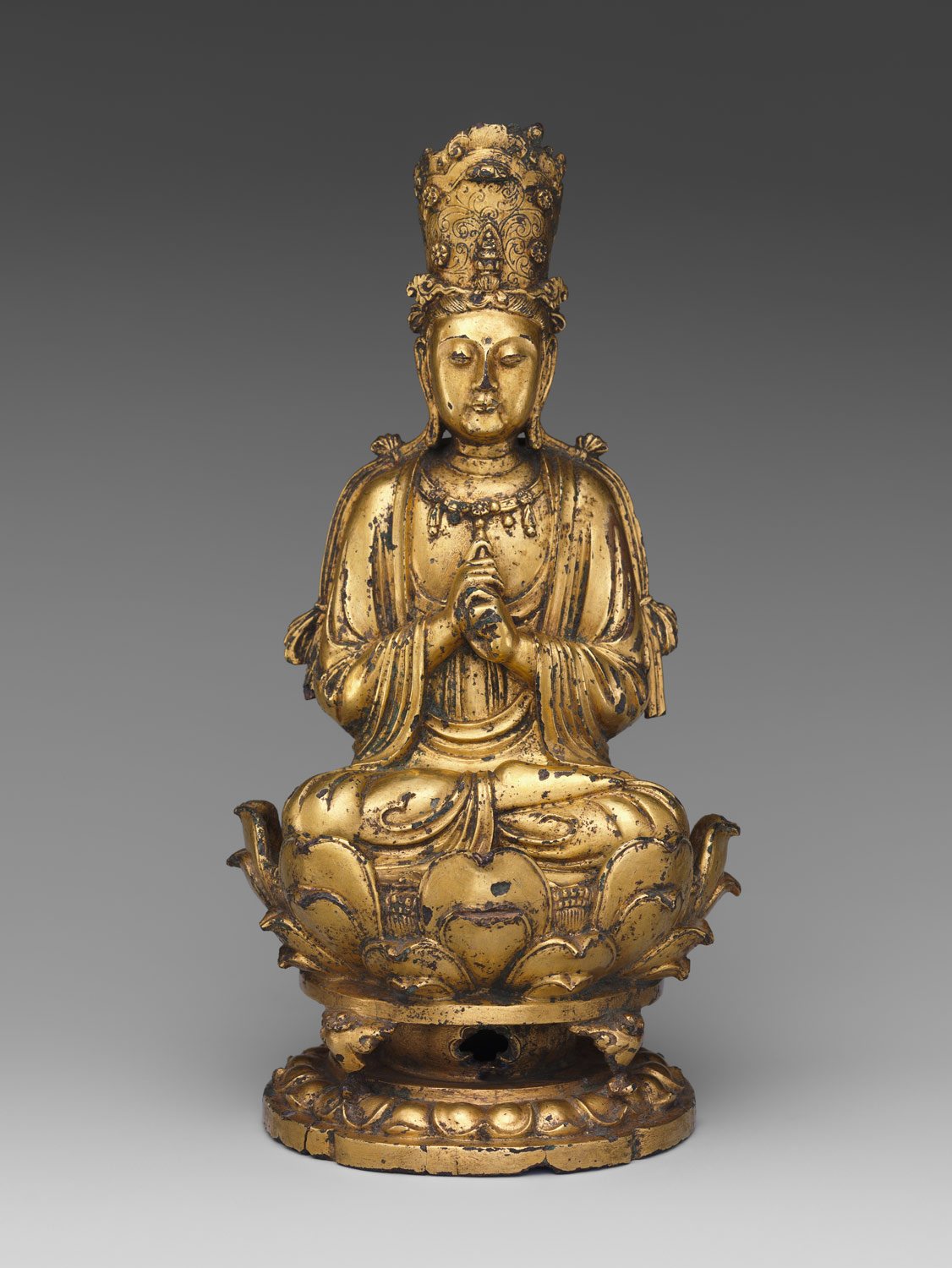
In contrast, the later statue, from China during the Tang Dynasty (7th to 10th century CE), reflects Mahayana Buddhism, the “greater vehicle” by which Buddhism was successfully introduced to the masses. Compared to the starved Buddha from 250 CE, the Tang Buddha has a normal build, perhaps indicating for adherents a secular station in life as opposed to one of monastic self-denial. Instead of being surrounded by monks, the Tang Buddha is alone, indicating to the viewer that s/he could also attain enlightenment. Finally, and perhaps most importantly, the Tang Buddha is made of gold rather than plain stone, indicating that the Buddhist can enjoy economic wealth in addition to (or perhaps despite) his/her religion.[2]

===

1. Jerry Bentley and Herbert Ziegler, Traditions and Encounters, Volume 1: To 1500, 3rd ed. (New York: McGraw-Hill, 2012), 128.
2. Ibid.

Conversion in Late Antiquity: Islam v. Christianity

Christianity and Islam are closely related religions, with the key differences between focusing mainly on their different understandings of Jesus and the latter’s emphasis on the prophesies of Muhammad. Although they are not the only Abrahamic faiths, they nevertheless spread rapidly in the century or two following their founding, and through today, their adherents make up almost half of humankind. The key aspect that they share, other than a clear belief in the same supreme being, is that they are both salvation religions, teaching that through a combination of belief and right conduct, human beings can obtain eternal life in Heaven after their physical life ends. Although this message was popular in late antiquity, there were other salvation religions that were ultimately less popular. Christianity and Islam were both successful, therefore, for reasons other than the message of salvation, but the most vital factors were actually for their individual successes were quite different.

Christianity was spread among people other than Jews, from among whom it originated, primarily through the ministry of St. Paul. Paul was a Jew from Tarsus in modern-day Turkey, but he held Roman citizenship, which he used to travel more freely than other people living under Roman rule might have. This freedom of movement significantly facilitated the success of St. Paul’s ministry. In addition, St. Paul, as well as the other first-generation leaders of the Christian church, spoke Greek as at least a second language if not their primary language; much of the Middle East and all of modern-day Turkey was Greek-speaking since its Hellenization by Alexander the Great. The dissemination of the Christian message in as widespread a language as Greek also greatly facilitated the spread of Christianity. Finally, once the Roman Emperor Constantine adopted Christianity as Rome’s state religion in the early fourth century, Christianity benefited enormously, not only from the elimination of Roman persecution of Christians, but also because the spread of Christianity could subsequently benefit from Roman political authority, resources, and trade routes.[1]

Islam seems to have benefited most in its initial period from the Muslim concept of jihad, or struggle. Although theological interpretation of the term has varied greatly over the 1,400-year history of Islam, it is relatively clear that, in this vital first period, during which Islam spread enormously, jihad entailed the spreading of the Islamic faith through force. Certainly, it is unquestioned, including by Muslims themselves, that Muhammad spread Islam from Medina to Mecca by the sword. As the Muslim world expanded, jihad worked hand in hand with less militant methods, including the offering of economic incentives to countries accepting Islamic rule, if not the Islamic faith itself. Although most communities that came under Muslim rule became Muslim themselves, small communities of Jews, Christians, and Zoroastrians enjoyed protected minority status under Islamic rule in exchange for the payment of a poll tax. This policy assured the continued spread of Islam by the consolidation of political authority without the need to forcibly convert subject populations.[2]

======

[1] Jerry Bentley and Herbert Ziegler, Traditions and Encounters, Volume 1: To 1500, 3rd ed. (New York: McGraw-Hill, 2012), 153-154.
[2] Ibid, 198-204.

Greece, Rome, Democracy

Although the Constitution of the United States borrowed from both Athenian democracy and the Roman Republic, I believe that, while Athenian democracy more closely resembles what most people think of when they consider democracy, the U.S. Constitution, particularly in its original form, more closely resembles the Roman Republic, particularly with regard to the institutions established to govern and the manner in which the people obtained representation through these institutions.
Ancient Athens operated on a model of direct democracy, in which the people regularly participated in aspects of governance, including legislation and trial by jury. In this regard, it differed significantly from the United States, which operates on a model of representative democracy, in which deputies are elected to represent constituencies of citizens every two years (although some states, notably California, in implementing extensive plebiscite systems, have adopted aspects of direct democracy). Regarding participation, only between 10% and 25% of the Athenian population — consisting entirely of free, property-owning, adult men — could participate. In this regard, Ancient Athens perhaps most closely resembled the early U.S., in which it was also true that only free (i.e., white), property-owning, adult men (21 years old) could vote.[1]
The Roman Republic, in contrast, endowed the greatest power in the Senate, which was a legislative body whose members were appointment by the consuls (the executive powers of the state), who in turn were elected by the patrician class, who in turn were the descendants of the original 100 members of the Senate. In this fashion, the Senate was a sort of closed society with a feedback loop of power concentrated in the hands of around 5% of the population. Eventually the plebian class was enfranchised through the creation of its own legislative assemblies and the office of tribune, although the Senate retained more power.[2]
In these regards, i.e., separation of executive and legislative power and a bicameral legislature with power unevenly distributed, the resemblance between the Roman Republic and the U.S. is clearest. However, the Athenian system is closer to what most people would regard as democracy. Neither had anything close to resembling universal suffrage, but the direct participation of  citizens in Ancient Athens and the greater equality among citizens without regard to class seem more democratic. In particular, because of its direct democracy, Ancient Athens actually seems more democratic than the U.S. today, in part because the U.S. is more a republic than a democracy.
=====
1. Mark Cartwright, “Athenian Democracy,” Ancient History Web site, accessed December 12, 2015, http://www.ancient.eu/Athenian_Democracy/
2.  Jerry Bentley and Herbert Ziegler, Traditions and Encounters, Volume 1: To 1500, 3rd ed. (New York: McGraw-Hill, 2012), 146.

Stuff I’m Reading

A History of Fascism, 1914-1945, Stanley G. Payne
Fascists, Michael Mann

Design a site like this with WordPress.com
Get started